
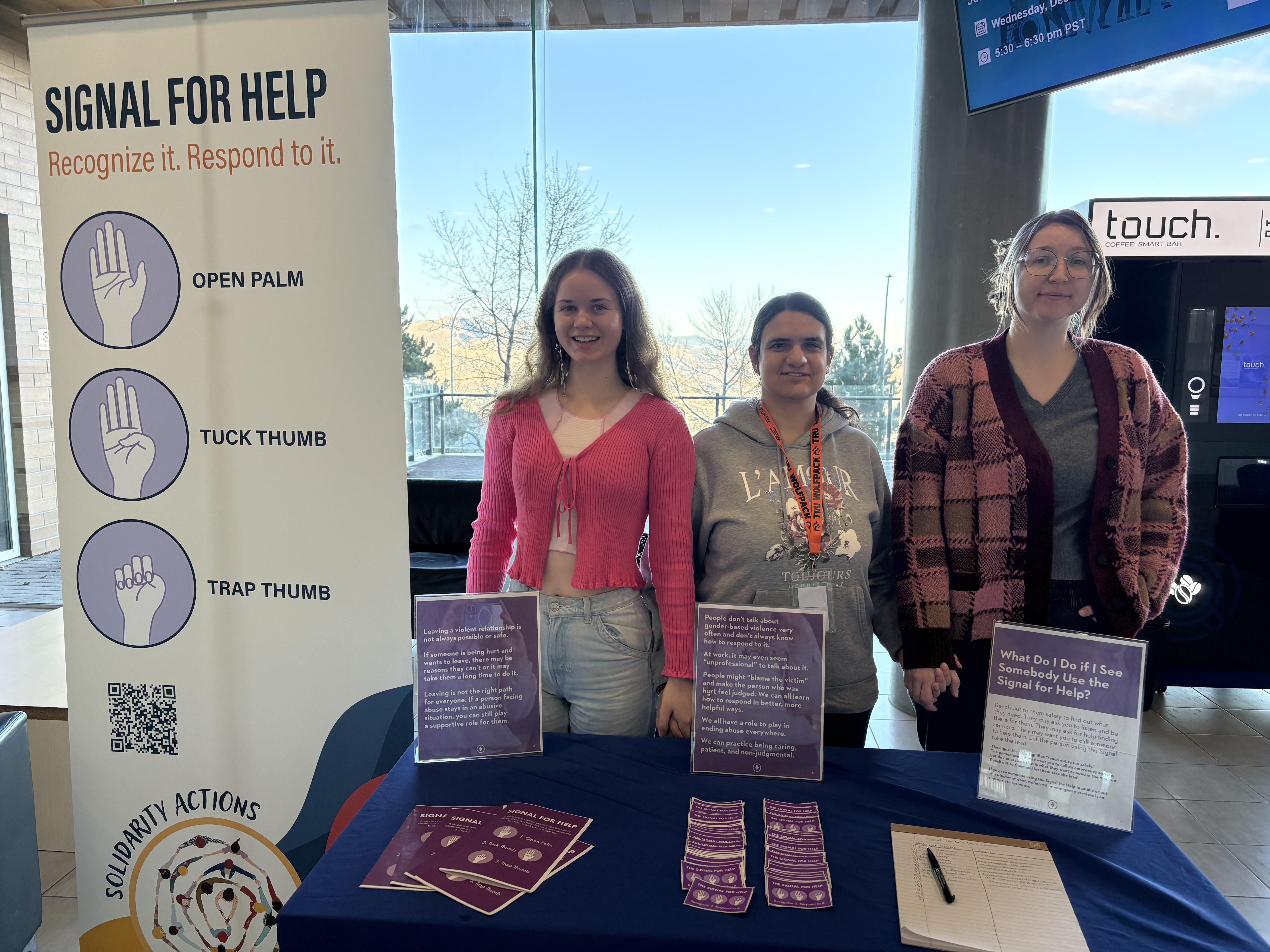
This November, the TRUSU equity committee has been teaching students about the Canadian Women’s Foundation’s Signal for Help: a way to recognize abuse.
The signal for help is a simple gesture that allows people ask for help when they are experiencing abuse, but may feel too unsafe to vocalize it. The gesture is done by holding your hand up with your palm facing outward, placing your thumb in the centre of your palm and folding your fingers over your thumb. The signal was designed to be discreet and easy to use.
It was created by the Canadian Women’s Foundation in April, 2020 as a result of the COVID-19 lockdowns. Evidence suggests that disaster situations can lead to an increase in gender-based violence, and the foundation believes that abusive or dangerous relationships would be exacerbated by the isolation caused by the pandemic.
Awareness of the signal has continued to grow since 2020. According to canadianwomen.org, the signal is used in 50 countries and 20 languages. Two out of five people in Canada know about the signal, and one in ten have used it or seen it used.
The TRUSU equity committee has been sharing the importance of the campaign through the Solidarity Action Program. Six times a year, the program highlights a different organization that strives to build equity in society. Signal for Help was chosen for November, and every Monday, the equity committee has set up a table on campus to share information about the campaign.
The table offers information about the signal, and pamphlets and stickers for students to take with them. Students can also participate in a quick activity where they are given a scenario in which they might see the signal used, such as while hanging out with a friend around a complete stranger, and think about about the best way to respond.
The core goal of the table and activity is to inform people about the Canadian Women’s Foundation’s online mini course, which teaches people how to appropriately respond when they learn someone is experiencing abuse. Although the signal is used in a time of need, it does not mean you should automatically contact emergency services, as different scenarios require different actions. The course is free, takes roughly one hour to complete and helps ensure the signal is effective and recognizable.
“The most important thing is knowing how to respond, because if you respond in a wrong way, you could say, it could actually put them in more danger,” said TRUSU Indigenous Representative Payton Maffioli. “That’s why you should take the course, because it does go through all those different situations and scenarios where you can learn how to respond appropriately and accordingly… We’re trying to emphasize taking the course as the key step to really making change in your community.”
The tables are set up in the Arts and Education Building, North Tower and the International Building. According to TRUSU equity coordinator Azul-Sky Billy, they avoid the high-traffic areas and instead choose locations where students typically keep to themselves, in an effort to make the outreach as impactful as possible.
“We’re finding that a lot of people have seen the signal itself, but haven’t really recognized that the other side of it is ‘how do we respond in a safe way, ‘” said Billy. “I think the big part is that we’re all taking action together. A lot of the time we see that there are all these things going on in the world, and it feels like ‘I want to do this thing, I want to act, but I don’t know how.’ We’re bringing that action to them so that they can not only learn, but also take action with us as a community.”
The TRUSU Equity Committee’s next outreach initiative will be in January, 2027, and will spotlight the $10-aDay child care centres in B.C..