
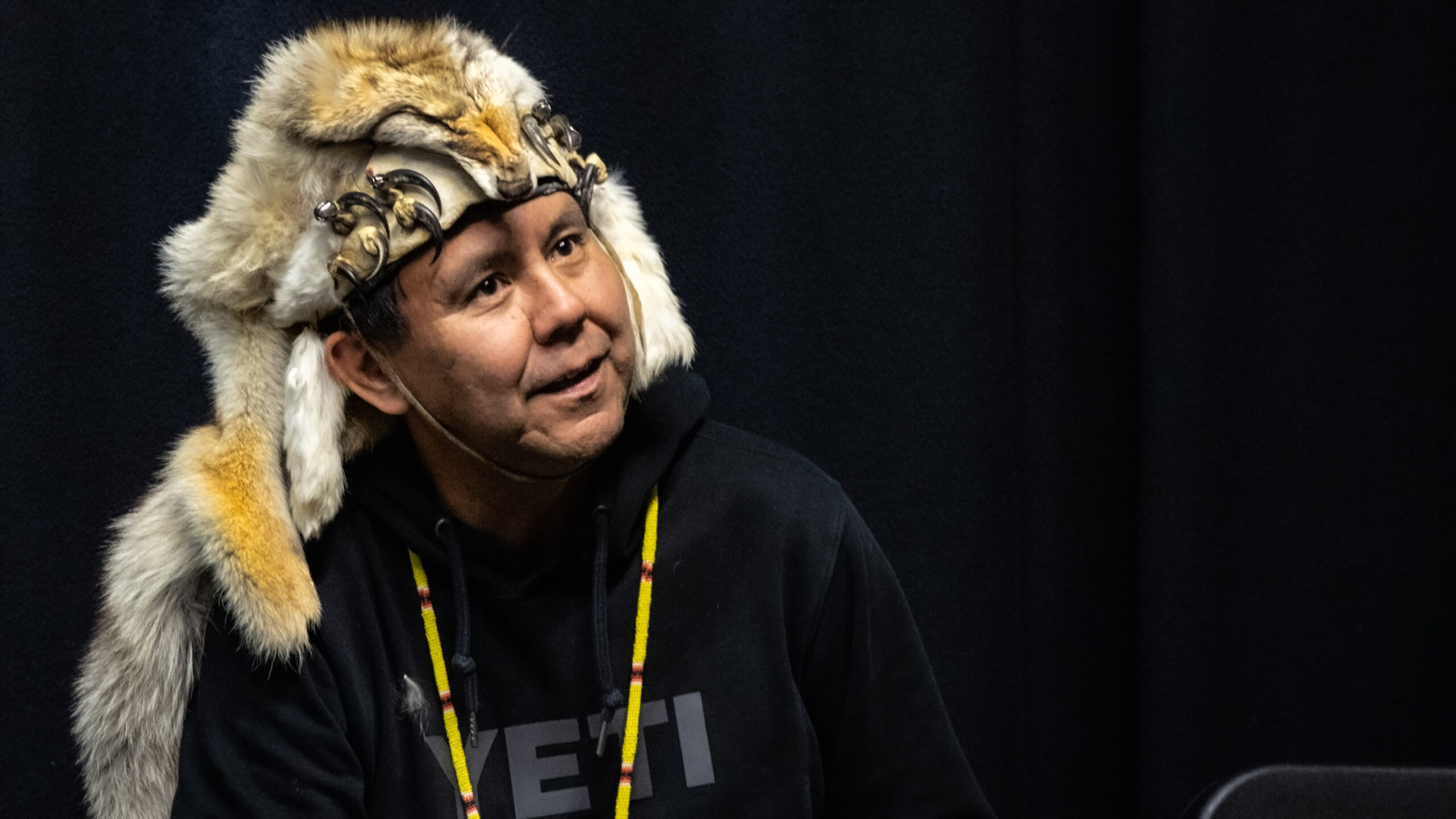
Secwépemc ways of knowing honour reciprocity, and believe that learning carries a responsibility to share such teachings should be shared. On Nov. 21 the Indigenous Pedagogies and Ways of Knowing course in the master of arts in HRSJ opened their classroom to master storyteller and educator, Kenthen Thomas, who shared three Stseptékwll with an audience of children, students and community members.
Stseptékwll are traditional oral stories known and practiced by the Indigenous community. But the Stseptékwll are more than stories or folklore, they are the very basis of the teachings, laws and epistemologies that have been practiced by the Secwépemc for time-immemorial.
What is especially distinct about Stseptékwll is that no telling is exactly the same. The tradition is passed down orally, and how it is communicated is context-dependent. “Usually I choose stories during my travels,” Thomas said. “So if I see a crow, I’ll do the story of the Crow. If I see an eagle, I’ll do a story about an eagle. But today, I was really watching the water, and there was a little rogue wave today that almost looked like a little monster or a sturgeon or something just swimming along.”
The first story told by Thomas was that of the Water Monster, which recounts the histories of what is now known as Adams Lake and the four warriors who were tasked with killing the salmon-stealing creature. “I heard that some of the denialists might be here today. So I felt that story would be really pertinent for them, because it’s a story that asks you what kind of warrior, or leader, you consider yourself to be,” Thomas said.
One of the warriors, embellished with muscles and a cedar canoe, had his chance of shooting the monster through the heart. “At first, [the warrior] started out with a good, strong paddle. As he started going out onto the lake, all of a sudden, he stopped. That warrior, the leader, he picked up his bow and arrow at first but then he put it down,” Thomas said as he rhythmically hit his drum. “Instead, he picked up his spear and that water monster created a whirlpool. He stayed up on the crest of the whirlpool the best he could and he had a shot right at the heart of that water monster but he hesitated. That was the last time anyone had ever seen or heard from him again.”
The fourth warrior, however, was patient and humble. Instead of fighting the monster head-on, he knew he needed more time to prepare, so he prayed. Alongside his village and ancestors, the warrior watched the water monster for days and crafted a strong cedar canoe. After proper preparation and praying with his ancestors, the warrior went to the middle of the lake and buried the monster. “Before I let you guys clap, this is the part where my ancestors will ask you, what kind of warrior do you consider yourself to be? Are you the kind that goes around in circles, spinning out, not really having any direction or purpose? Some days you’re kind, giving and altruistic, and other days you’re downright rotten, mean and a bully. What kind of warrior are you?”
Despite being ancient to the culture of the Secwépemc, these teachings remain especially relevant today in the face of political uncertainty. Concerns over the rights and freedoms of the Indigenous community have been on the rise this year, with appearances of far-right group Second Sons of Canada and other residential school denialists. Now, with a historically-unprecedented majority conservative provincial government, the community continues to face uncertainty as political parties attempt to repeal protective legislation which secures the rights and freedoms of Indigenous people across the country.
More specifically, political parties such as OneBC and the newly-elected Conservative Party of Canada are attempting to repeal the Declaration on the Rights of Indigenous Peoples (DRIPA), which outlines the human rights of Indigenous peoples and aims to strengthen Truth and Reconciliation. With the justification of economic benefit, the ultimate goal is to further industrialization with little recourse.
Aside from the environments decimated, Indigenous people across Canada have, and continue to, face endless systemic inequalities. For instructors Jenna Woodrow and Tracey Strain, who teach the MA HRSJ Indigenous Pedagogies and Ways of Knowing (HRSJ 5020) course, such hatred is incompatible with the values of the Secwepemcúlecw.
“We want to live in a world of peace and love, and we want to share stories of how we love the land here. We love our children. I want people to do the same, and to love our territory,” Strain said. “I want [people] to see them as the beautiful little people that they are. [Children] give us so much joy, and they teach us so much.”
Thomas shared a second Stseptékwll, about a stolen baby boy. In the story, a mother warns her child to stop crying so that he isn’t stolen by the Owl. The Owl hears this and steals the baby and raises him to hunt, washing the child in cold water for strength and fir branches for wisdom. Eventually, the child grows up and is reunited with his family who had never stopped searching for their baby boy. The warrior then uses his powers against Owl, tricking him and transforming him from a cunning force to an ordinary bird.
“I need to make sure Owl will never do this to another human ever again… So, [the warrior] used Owl’s own powers against him and defeated him,” Thomas said. “He said, ‘I have every right to kill you for interfering in the lives of all those humans and the children that were taken by you’.” Instead of killing the bird, the warrior used his strength to take Owl’s gifts. “This is what happens when you mistreat our young people.”
For Thomas, the Stseptékwll is a lived reality and closely parallels the storyteller’s own life as a child who was kidnapped from his mother at birth by social workers and sold for profit. It should not come as a surprise to know that, although this is an ancient story, it remains unfortunately relevant today as Indigenous children are often targeted by the government and state actors.
In an auditorium of both settlers and Indigenous folk, students and school-children, there was space for learning and appreciation of the ancient teachings within the Stseptékwll. Courses such as HRSJ5020 serve as active-resistance to colonial ignorance.
“The Faculty of Arts and the Human Rights and Social Justice program deserve recognition for creating this course and making it an essential part of students’ learning,” Woodrow said.