
This Sep. 29, the Kamloops community came together in two separate events to honour the National Day for Truth and Reconciliation.
Earlier in the day, the Common Grounds Coffe Shop was set up with a podium, a blue TRU banner, and four rows of white chairs. A few minutes before the official kick-off, TRU faculty and students started filling up the space, some in traditional skirts and jewelry, but most donning the orange shirt, a symbol for the commemorative holiday.
The Orange Shirt movement began in May of 2013 as a legacy of the St. Joseph Mission Residential School in Williams Lake, B.C., which only closed down in 1981. Esk’etemc Chief Fred Robbins, who attended St. Joseph, envisioned the commemoration project.
When survivor Phyllis (Jack) Webstand arrived on her first day at the school, she was just six years old. She’d arrived in a bright new orange shirt, purchased by her grandmother. But the cruelty of the environment became immediately apparent. “They stripped me, and took away my clothes, including the orange shirt!” Webstand shared. “I never wore it again.”
Now, the orange shirt is worn by many to honour every child, and remember, per the Governemnt of Canada, “the loss of culture, freedom and self-esteem that many Indigenous children experienced.”
A TRU community comes together
The yearly commemorative event organized by the TRU Office of Indigenous Education began at around 11:10 am with an opening prayer and a welcome to the territory by Elder Diena Jules, a member of T’kemlúps te Secwépmec, a residential school and day scholar survivor. With Jules came a special guest, who opened the ceremony with a song.
Chancellor Dede DeRose, a member of the Esk’etemc First Nations and a third-generation residential school survivor, followed Elder Jules’ words.
“Today, we remember the children. We remember those taken from our families and nations and those who were denied the chance to learn our languages, cultures and ways of life.” DeRose continued, “We remember the children who laid awake, longing for home, who endured loneliness, hunger, fear, abuse and neglect.”
The T’kemlúps te Secwépmec Chief and Chancellor highlighted how education was used then and now, emphasizing the role educators should take; from being used as an instrument of cultural assimilation and harm, education must the lead from Truth to Reconciliation, she said.
TRU president Airini, appearing at the event in a large orange coat, opened her speech with appreciation for the speaker and participants of that day. She later mentioned the ways TRU remains committed to “exceptional consideration” for Secwépmec people daily; including learning from the Truth and Reconciliation Commission reports, courses, research, and the Coyote Project.
The TRU president concluded with a call for change, remembering the story of an indigenous beaded work titled One Bead at a Time she once saw at a coffee shop in Kamloops, “Tomorrow we won’t finish this work, but tomorrow we can take another step; one step at a time. One bead at a time, we’ll weave what is needed.”
Despite incoming rain, most stayed to hear Secwépmec elder Jo-Anne Gottfriedson share her journey as a third-generation survivor who attended the Kamloops Residential School.
“We were treated, as day scholars, like immigrants in our own land,” Gottfriedson said, before sharing the treatment her mom and friend went through at their residential school.
As Gottfriedson noted the perseverance of her elders, who now share their culture, ceremonies and ways of being with mutual respect, the smell of medicinal smoke filled the Common Grounds area. The Indian Residential School Survivors Society prepared the smudging ceremony to purify the body, mind, heart and spirit at the program’s conclusion.
Intimidation and Denialism
“We are not wearing masks. We don’t have to hide behind the truth. We are the truth. We lived it,” Gottfriedson said in her speech, apparently alluding to the white nationalist group that, just days earlier, rallied near the Kamloops Indian Residential School.
As the TRU event was concluding, a flash mob was starting to build at the other side of town in response to the group. During the rally, the masked men held up signs that appeared to deny the 2021 Tk’emlúps te Secwépmec findings of mass graves on the residential school grounds.
According to CBC, Tk’emlúps te Secwépmec hired a specialist in ground-penetrating technology to search the Sacred Site and other areas of the former Kamloops Indian Residential School, which was run by the Catholic Church and later by the Federal Government until its closure.
The preliminary findings identified the unmarked burials of 200 children, and the independent investigation has been ongoing.
Truth and Reconciliation Day Flash Mob
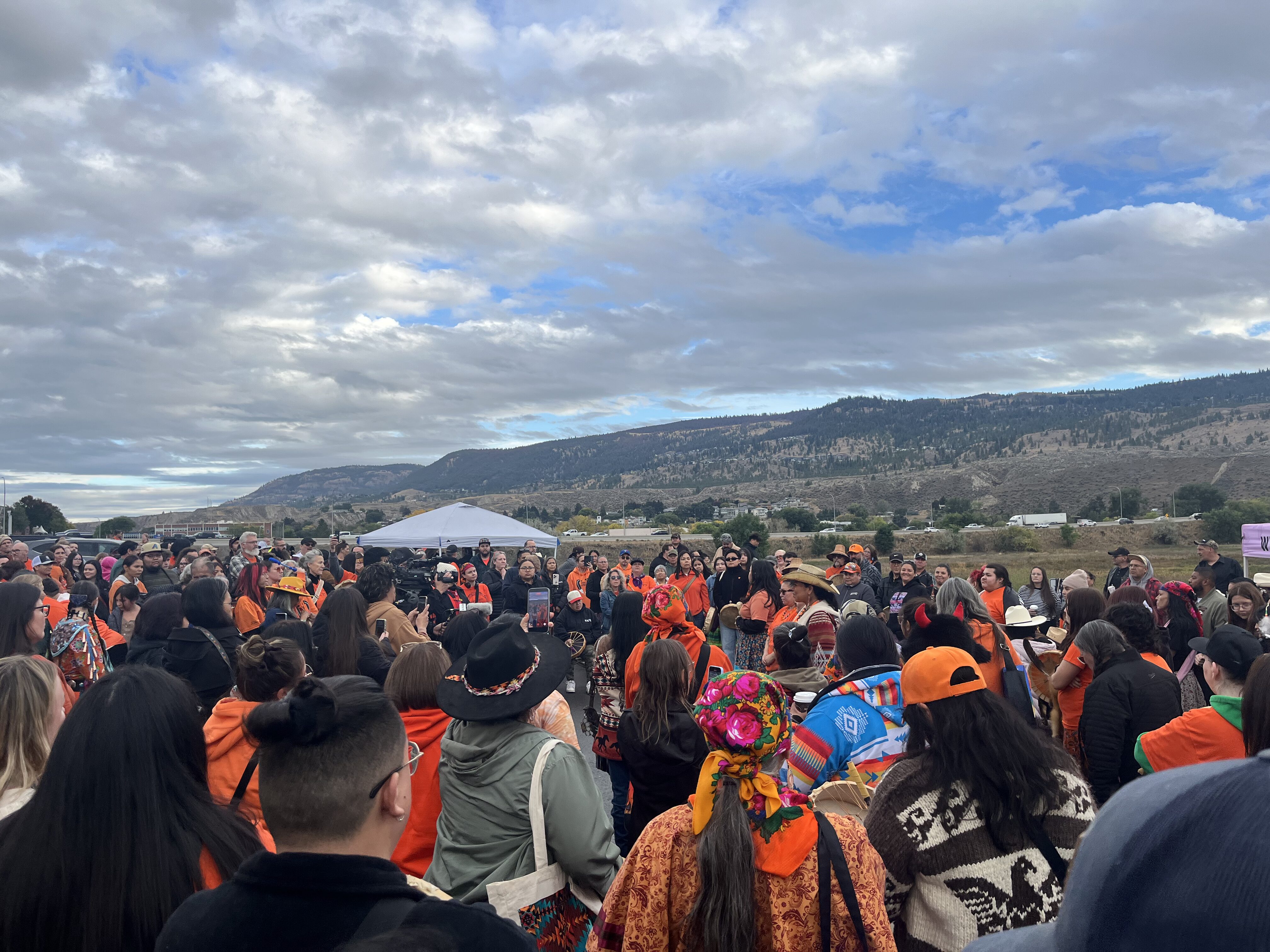
At around 4 p.m., the grey clouds had turned into a bright sun, and around 400 community members reunited to cleanse the area for Sep. 30.
“Our community has survived attempts to remove us from our lands, languages, families and cultures but we are still here,” event organizers were reported saying.
“White supremacy, racism and hate have no place on Secwépemcúl’ecw.”
In between songs, elders were invited to address the audience, although their words were hard to hear due the din of the large crowd.
For two and half hours, people sang, danced and stood together.
Though security was present for both events, the flash mob organizers secured a tighter team. While the TRU event was accompanied by Paladin security and a couple of police officers, the second was covered by a larger police team, allies and warriors.
The last two groups, which were given a red band at the start of the ceremony, consisted of attendees that were voluntarily smudged to protect the community in case an emergency occurred.
With the goal of cleansing bad energy, the event concluded with a march led by a young man on a horse, starting at the complex to the road where the white nationalist group appeared.