
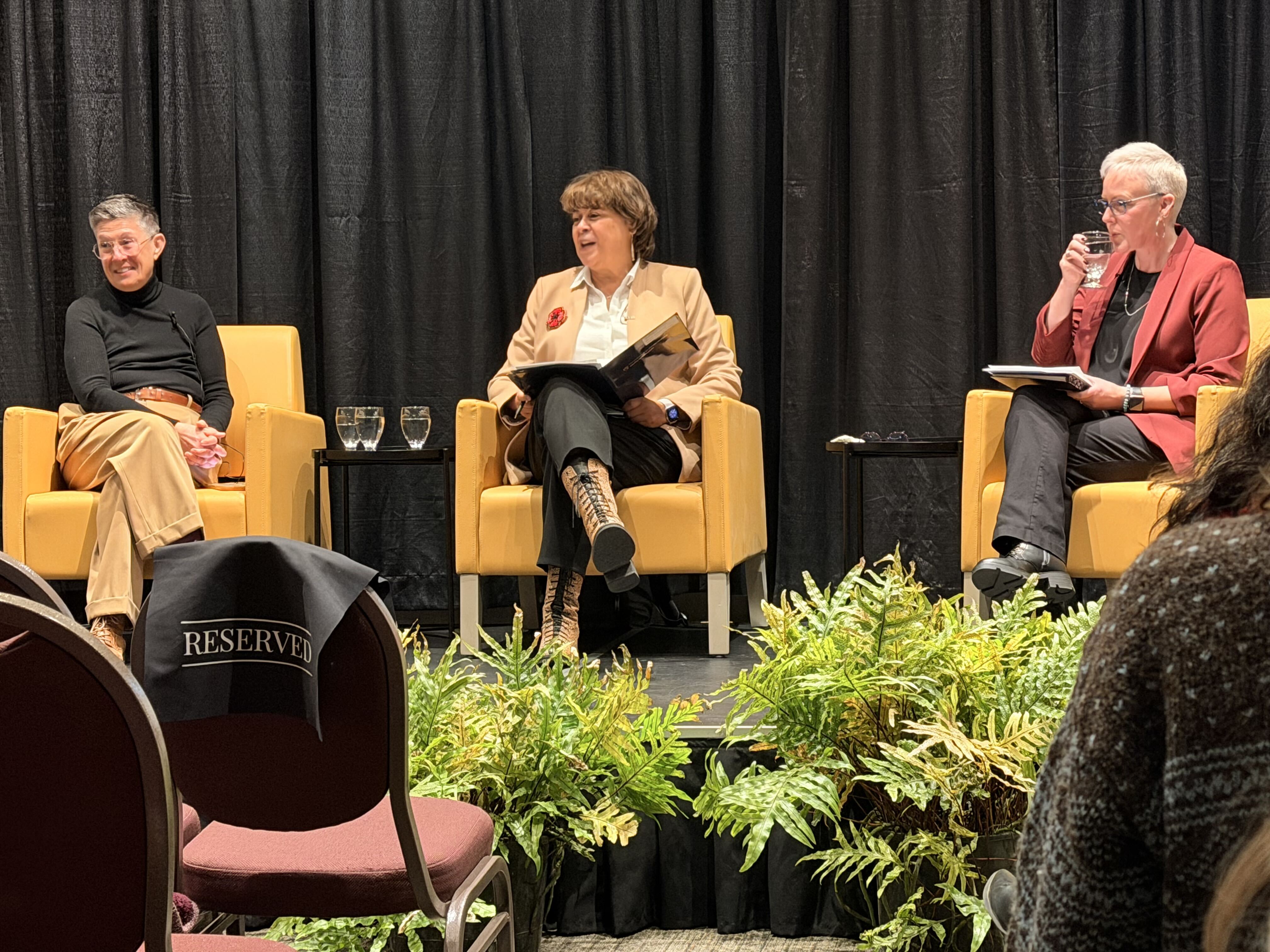
On Nov. 9, TRU hosted its fourth annual Women in Leadership series and was joined by Dr. Jan Hare from UBC and Dr. El Chenier from SFU.
It is no new knowledge that women have had to endure a long withstanding fight to acquire basic rights such as access to education, voting and the freedom of choice. Across history, women of all nationalities, genders and sexualities have lobbied tirelessly, and continue to do so, to attain and maintain basic human rights.
For guest-speaker Hare, her area of interest is situated within Indigenous rights and education. Her research asks how education can better serve Indigenous learners, and how to give Indigenous knowledge and languages a central place in learning. In addition to her research, she holds a role as Dean of the UBC faculty of education.
“I’ve come to see myself as always part of something larger,” Hare said. “I see myself in relation to other ecosystems, whether that’s where I work, or whether it’s my family.”
The evening lecture raised several points of discussion, most prominent of which was the difficulty for women in navigating racial and gender identity simultaneously. “As an Indigenous woman, I experience things differently,” Hare said. “We all experience identity differently, based on our intersectionality.”
The analytical frame of intersectionality highlights layers of privilege through social and political identities such as gender, race, class, age, abilities and religion. This framework gestures at the ways oppression is experienced differently for white, straight, cis-gender women than it is for women of colour, queer and trans women, or women of diverse abilities.
As an Indigenous woman, and as a scholar, Hare noted that it can be isolating. “I’m often perceived as only being able to do Indigenous stuff… I’m valued as a sort of a marker of diversity, and yet my contributions are often ignored.”
Chenier’s research focuses on bringing feminist, anti-racist, anti-colonial and queer perspectives to the history of sexuality and gender. Chenier is also credited for having founded the Archives of Lesbian Oral Testimony, Canada’s first archive of lesbian history. “I discovered feminism in university, and came out around the same time, and that’s when I discovered: it’s not you, it’s the system.”
As a leading academic of queer liberation movements, Chenier said that it was the university experience that changed their shame into pride.
Provost and Vice-President academic Dr. Gordon Binsted opened the lecture by introducing the audience to his late nanny, Peggy Binsted, who served as part of the British Air Force during World War 2. “I’ve got a picture on my bedside table of [my nanny] in her full flight suit, standing next to a World War 2 fighting plane. She was part of the women of the force who trained Allied pilots in Montreal and Nova Scotia,” the provost said. “But, the scale of what she did. That picture gives me a glimpse into her world.”
EDI manager, Keisha Morong, then took to the stage to share a more current personal anecdote about the women in her life and how she honours them, for instance, Morong’s pants. “I wanted to bring up my lovely pants, and there’s a reason for that. My mama made me these pants.” She said, “There’s lots of sewing and everything is very colourful and bright. They have been sitting in my closet for a bit, they are a little tight, but I wanted my mama on the stage with me today. I really reflect on my mom, grandmother and aunties who taught me what being a woman and a leader means to me.”
The event’s moderator, Dr. Amie McLean, spoke on the ongoing threats towards women’s rights within contemporary settings. “We are seeing the mobilization of attacks on Indigenous rights, and responsibilities towards decolonization that are intrinsic to the defence of patriarchal colonial hierarchies. We are seeing that the ways in which recent attacks on women’s rights and gender equity are part of an organized backlash that challenges not only legal protections, but also who can exercise authority, produce knowledge, and participate safely in public life,” McLean said. “But the thing is that in classrooms, in workplaces, in communities, they are turning into collective strength. Turning resistance into practices of solidarity.”