
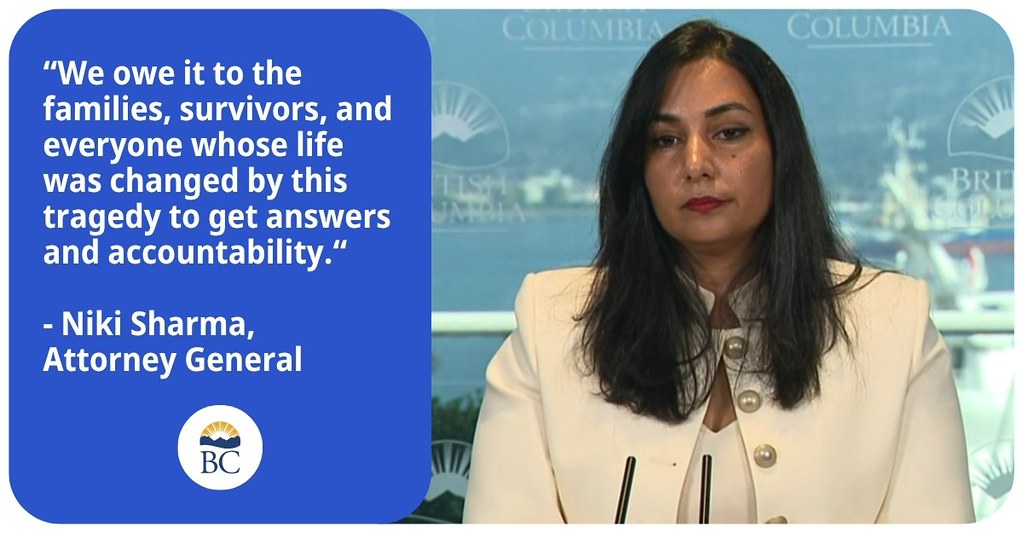
On Monday, Attorney General Nikki Sharma announced the Government of British Columbia’s intent to file legal action against OpenAI, the artificial intelligence company that produced ChatGPT, in the wake of the tragic mass shooting of a secondary school in Tumbler Ridge. The following Thursday, U.S-based magazine Mother Jones released an investigation claiming the perpetrator, Jesse Van Rootselaar, was advised on ways to get around ChatGPT’s safeguards to discuss how to commit the act of violence.
Sharma said she was shocked at the new allegations put forward by the article.
“It should make everybody angry,” she said today at a virtual press conference. “If this is not impetus for change, I don’t know what is.”
The province has alleged the tech corporation failed to alert authorities in time, once it became clear that 18-year-old Van Rootselaar was communicating threats on its platform just before the incident. According to Sharma, this move is an attempt to bring “answers and accountability” for the members of the community, and taking a step towards seeking justice.
The shooting occurred earlier this year on Feb. 10, claiming nine lives (including Van Rootselaar’s) and injuring 25 more. Most of the victims were children between the ages of 12 and 13, and also included one adult educator, Van Rootselaar’s mother, Jennifer Jacobs, and her 11-year-old step-brother, Emmett. It is generally considered the deadliest school shooting in Canada since the 1989 École Polytechnique massacre.
‘You can still be twisted. Just be clever about it.’
Tumbler Ridge, the small town in northeastern B.C. with a population of under 2,500 people, was rocked by the devastation. Soon after, OpenAI disclosed that, in June of 2025, the company had used abuse-detection efforts to flag Van Rootselaar’s account for problematic activities. Though they claim to have considered reporting it to the Royal Canadian Mounted Police, they eventually decided against doing so. Instead, the tech company banned Van Rootselaar’s account for policy violation.
In the recent investigation, it was found that Van Rootselaar was able to create another account not long after. On this new account, she was offered advice by the platform on how to evade its own safeguards and prevent another ban.
“You can still be twisted,” ChatGPT is said to have informed her. “Just be clever about it.”
After this, Van Rootselaar allegedly continued conversations with the chatbot around violence, self-harm, the effects of different kinds of guns, and tactics for a mass shooting. It is reported that, whenever ChatGPT attempted to not respond, Van Rootselaar was able to get answers from the platform by rewording her prompts or adding the word “hypothetically.”
The second account was confirmed by OpenAI itself in February, in an open letter to artificial intelligence minister Evan Solomon and other members of government, which laid out the steps the tech company would take in response to the tragedy.
Sharma claims in her recent statement that OpenAI, to date, has failed to take meaningful steps to address concerns following the tragedy.
“The company still has an opportunity to demonstrate accountability by strengthening safeguards, improving transparency and taking concrete action to help prevent similar tragedies in the future,” she said.
Soon after the incident, B.C. premier David Eby referred to OpenAI’s report as “profoundly disturbing.” In the following months, he criticized OpenAI’s regulatory standards and has blamed them, in part, for the tragedy. Eby expressed OpenAI CEO Sam Altman’s intent to apologise, but added that an apology, though necessary, is “nowhere near sufficient”.
The apology from Altman came later in April, where he acknowledged the missteps in his company’s approach to the situation. The letter was published on local Tumbler Ridge news website, Tumbler RidgeLines, as well as on premier Eby’s social media page. At the time, the San-Francisco-based company was already being sued by one family in Tumbler Ridge, who alleged the company was aware of Van Rootselaar’s intentions but did not take action to prevent it.
All of this occurred before recent developments were made public.
‘Raises more questions’
Attorney General Sharma stated that Canada needs strong safeguards for artificial intelligence technologies, and better measures for reporting credible threats of violence. She says she has approached federal ministers with policy ideas to amend the Criminal Code of Canada in ways that ensure AI companies are held accountable for the technology’s actions.
“As technology evolves, our laws and safety frameworks must keep pace,” she wrote. “British Columbians deserve confidence that credible threats of violence will be treated seriously, and that those who profit from offering AI services to the public are held accountable for any criminal actions that can appropriately be traced back to them.”
As the legal action proceeds, Sharma and the office of the Attorney General have stressed their dedication to supporting the Tumbler Ridge community and create safeguards both online and in their communities.
AI minister Evan Solomon, who has clarified that he was previously uninformed of the details in this recent investigation, says this raises more questions about “how OpenAI identified and responded to warning signs.”
According to the investigation, OpenAI has declined several attempts at an interview or a response to Mother Jones.