
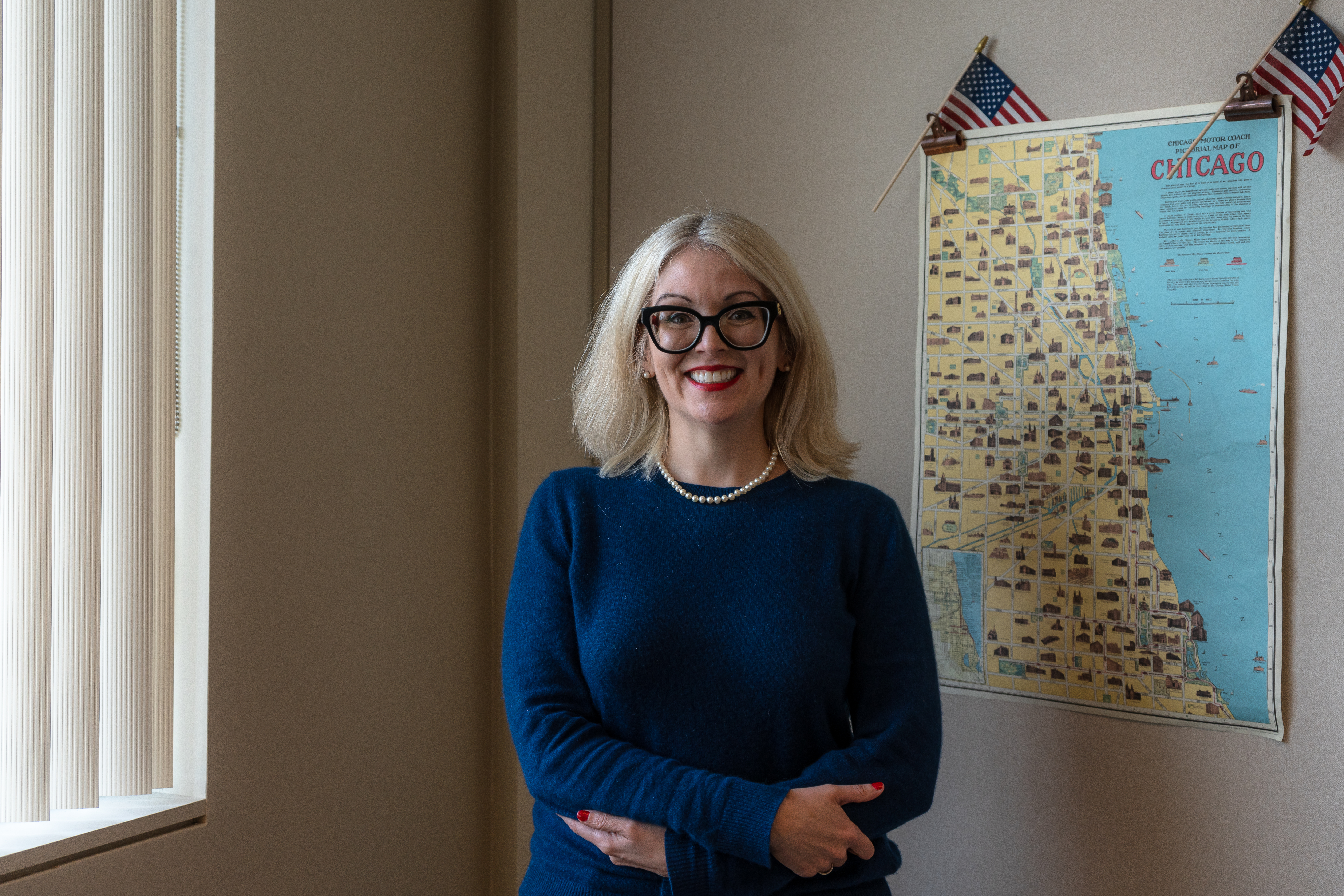
For TRU history professor Alana Toulin, becoming an academic was never part of a carefully laid-out plan.
“I kind of became a professor by accident,” Toulin said.
Before becoming a professor, Toulin worked as a student journalist. She studied history as an undergraduate at Western University, where she contributed to the Ottawa Citizen. She later moved to Thunder Bay, Ontario where she spent nearly two years working as a reporter before returning to Ottawa and taking a corporate job as a technical writer.
The work was not fulfilling, and Toulin decided to return to school.
In her early 30s, she began a master’s degree in history at Carleton University. After finding success in the program, she continued her studies, where she earned a PhD in history from Northwestern University in Chicago.
“I knew I wanted to study the U.S., in the U.S., so I looked into American doctoral programs, wrote the GRE, applied to a bunch of schools, both in Canada and the U.S., and ended up at Northwestern, which is what brought me to Chicago.”
Although she initially entered graduate school intending to study American imperialism and the U.S. colonization of the Philippines, her plans changed after falling in love with Chicago.
Toulin describes Chicago as a “city of neighbourhoods,” noting that the city has 77 defined community areas, each with its own history and character. Her interest in the city reflects her broader passion for understanding how people and culture shape history.
Her academic interests extend beyond traditional political history. Toulin considers herself a cultural historian with a particular interest in consumer culture, food and pop culture.
Her interest in food history began with her master’s thesis, which examined food advertising and the Pure Food movement. “Even as a journalist, I used to love doing work for the Saturday Style section, where there are articles about food and fashion. So being an academic allows me to explore those topics in a deeper way, more detailed than I would get to as a journalist.” Toulin said.
That connection between popular culture and history is especially apparent in one of her favourite courses to teach: History 3370, which invites students to encounter a history of the United States from 1945 to the present taught through film.
The course uses movies as primary sources, allowing students examine American society and culture through the films produced during different periods.
Movies such as Rebel Without a Cause (1955), Who’s Afraid of Virginia Woolf? (1966) and Network (1976) are used to examine different eras of American history. Toulin said Network (1976), remains particularly relevant to the modern media environment.
“There were all sorts of big pieces about how Network (1976) predicted the rise of Donald Trump,” Toulin said.
Her passion for film extends beyond the classroom. Some of her favourite movies include Boogie Nights and Trainspotting, both from the 1990s — a decade she associates with her own adolescence and the culture that she was surrounded by.
Toulin also has a less conventional way of enjoying movies: “Trash Night.”
The motto of Trash Night is watch garbage, eat garbage, be garbage
The tradition began with her friends in Chicago and eventually followed her to Kamloops. The concept is simple: watch terrible movies, eat junk food and enjoy the experience together.
“The motto of Trash Night is watch garbage, eat garbage, be garbage,” Toulin said.
Her favourite “trash movie” is Showgirls (1995), which has since developed a cult following despite its initially poor reception.
While film provides a way for Toulin to explore the past, she also sees history itself as a way of understanding the present.
She points to the Gilded Age and Progressive Era as useful periods for understanding contemporary society, especially the development of corporate capitalism. Questions surrounding the U.S. Constitution, political power and how united the country is, can all be traced back to the nation’s earliest history.
“I’m teaching, this term, the first half of the survey course: the United States from the colonial period to the Civil War. And so many of the issues from early U.S. history are still with us today. Thinking about, well, what did the founding fathers mean when they wrote the Constitution?” Toulin said.
Toulin’s own path to TRU was shaped by a similarly unpredictable series of events.
After completing her PhD in 2020, she entered the academic job market just as the COVID-19 pandemic disrupted universities across North America. She defended her dissertation over Zoom and saw academic job postings disappear as institutions responded to the pandemic.
Eventually, she accepted a three-year limited-term position at Dalhousie University in Halifax. While there, she continued applying for tenure-track positions.
One of those opportunities eventually brought her to TRU.
A former colleague from Carleton University, historian Nicholas Hyrnyk, was already working at TRU and told Toulin about an opening for a U.S. historian.
She applied, visited the Kamloops campus and ultimately received the position.
For Toulin, securing a tenure-track position was significant. She described such positions in her field as extremely difficult to obtain because of the number of scholars competing for relatively few jobs.
She moved to Kamloops in August 2023 and is now in her fourth year at TRU.
Although Kamloops was far from her home in Ottawa, Toulin said she has settled into the community. Hyrnyk helped introduce her to people in Kamloops, including a trivia team she now plays on.
Despite her enjoyment of teaching and research, Toulin admits that studying history can sometimes leave her pessimistic about the future.
We’re all sort of powerless as we’re swept along in the tides of history. All we can do is kind of control what’s in front of us.
Historians, she said, often find themselves watching society repeat patterns from the past despite warnings. Yet she also finds optimism in the fact that every generation has faced its own crises.
“We’re all sort of powerless as we’re swept along in the tides of history,” Toulin said. “All we can do is kind of control what’s in front of us.”
For Toulin, one of the strongest reasons for optimism is the next generation of historians. She said the students she teaches are passionate about studying the past and applying what they learn to the present.
“The next generation is always coming up behind us ready to kind of build on what we did and make it better,” Toulin said.
And through her courses, research and love of film, she continues to encourage students to look backward, not simply to understand history, but to understand the world they are living in now.