
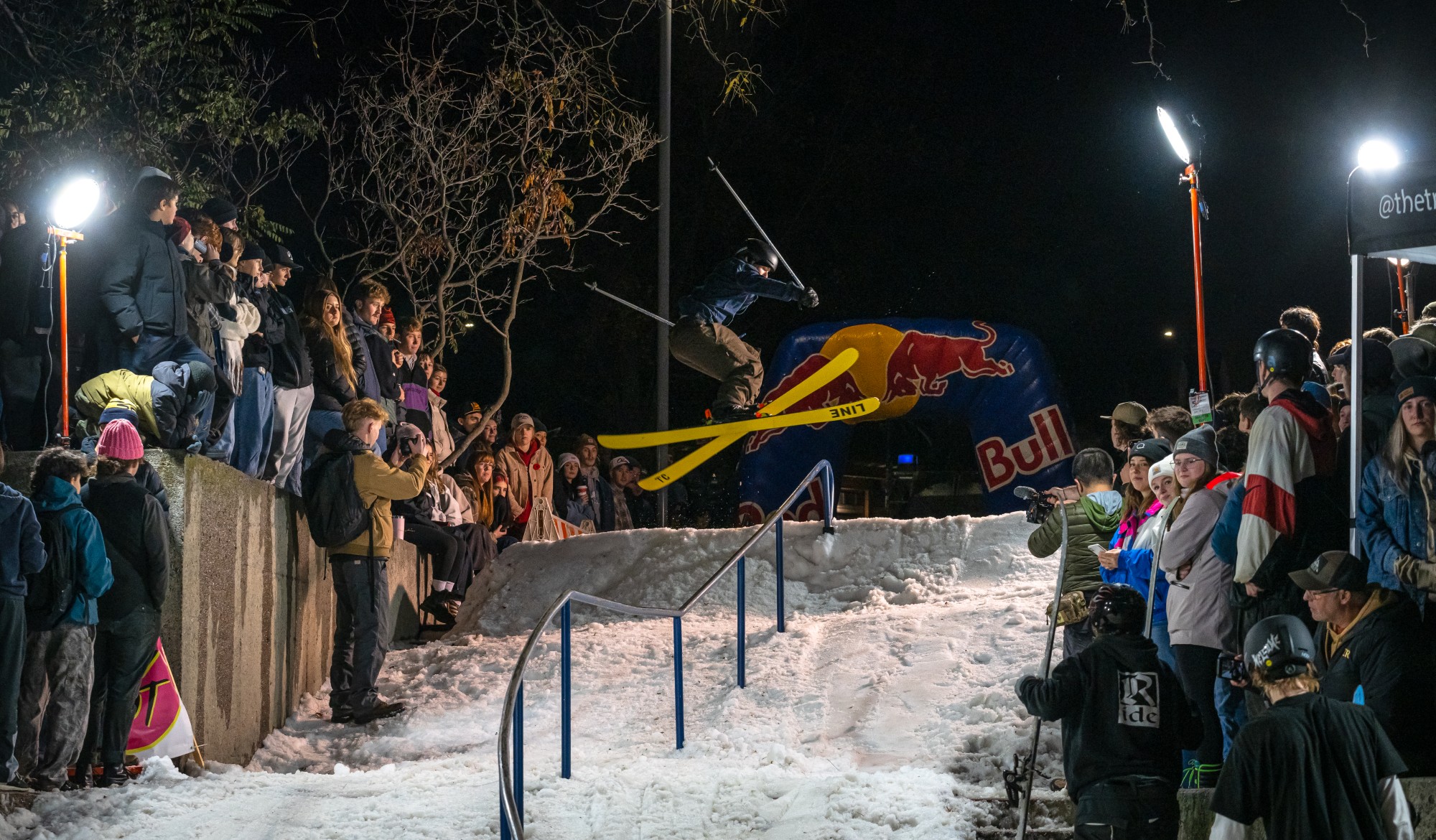
What started as a university class project has grown into one of Kamloops’ more unique winter sporting events, bringing skiers and snowboarders together at TRU for an evening of rail-jumping demonstrations.
Rail Riot, founded by former TRU student Justin Tarasoff, will return to campus on Nov. 20, bringing athletes from across Western Canada to showcase their skills in an urban skiing and snowboarding competition.
Tarasoff, 25, first came up with the idea while taking an event management course at TRU. A passionate skier, he recalled noticing a rail on campus during his university tour in 2021 and immediately seeing its potential.
“I was like, holy, this would be amazing to ride,” Tarasoff said.
After repeatedly attempting to ski the rail and being asked to leave campus by security, Tarasoff approached his instructor, Billy Collins, to find a way to make it happen.
Collins suggested organizing an official event, allowing athletes to use the space safely and with university approval.
That idea eventually became Rail Riot.
Now preparing for its fourth edition, Tarasoff said the event requires months of planning and collaboration with sponsors, volunteers, local skating rinks and TRU’s risk management office.
One of the biggest challenges is securing enough snow.
With Kamloops’ unpredictable winter conditions, organizers cannot rely on natural snowfall. Instead, they work with local skating rinks to collect snow produced by Zambonis when maintaining the ice.
Organizers collect the snow from facilities including McArthur Island and the Sandman Centre, transporting it to campus using a dump trailer donated by Cooper Rentals.
The snow is then piled, compacted and covered with tarps in preparation for the event.
“We haven’t had a Rail Riot with natural snow yet,” Tarasoff said.
He credited much of the event’s success to the support of TRU’s risk management office, which works with organizers to assess potential hazards, review safety plans and coordinate event logistics.
Tarasoff said every event of this scale requires a risk management plan to be reviewed and approved before it can proceed. With athletes performing skiing and snowboarding tricks on rails and other obstacles in a public university space, ensuring the event is properly organized and insured is an important part of the planning process.
He said the relationship between Rail Riot and TRU’s risk management office has been particularly important, noting that other universities have been less receptive to similar ideas.
Tarasoff recalled speaking with representatives from the University of British Columbia Okanagan’s risk management office in Kelowna, who questioned how TRU had been able to approve an event like Rail Riot.
“We are super lucky to have the risk office we do have that supports this,” he said.
Beyond the competition itself, Tarasoff said one of Rail Riot’s main goals is making skiing and snowboarding more accessible to people who might otherwise believe they need to travel to a mountain resort to participate.
“I started this because I wanted to show people you really just need a little bit of snow and a tiny hill,” he said. “You can do it anywhere if you put your mind to it.”
Tarasoff also sees the event as an opportunity to strengthen Kamloops’ winter sports culture and bring more attention to TRU.
Despite being close to Sun Peaks Resort, Kamloops has relatively few opportunities for urban skiing events. Rail Riot is currently the city’s only rail jam, and he hopes the event can help build excitement ahead of the ski season while giving local and visiting athletes an opportunity to showcase their abilities.
Athletes are selected through Tarasoff’s connections within the skiing and snowboarding communities, with participants coming from across British Columbia, Alberta and other parts of Western Canada.
This year, organizers have also introduced an online application process, allowing aspiring athletes to submit videos of their tricks and apply for a spot.
Tarasoff said the addition creates more opportunities for athletes who might not otherwise have personal connections within the industry.
The event also emphasizes community involvement rather than financial gain.
“Rail Riot actually makes zero money,” Tarasoff said. “We make no profit off this. We invest all of it back into [the event].”
With support from sponsors including Tourism Kamloops, Sun Peaks and Spoke Bike and Ski, Tarasoff hopes to continue developing the event while establishing a structure that allows it to operate beyond his own involvement.
He said future possibilities include a beer garden and a large screen, while this year’s event will also be livestreamed on YouTube.
Ultimately, Tarasoff wants Rail Riot to become a lasting part of TRU’s campus culture.
“I want it to become a community tradition at TRU,” he said. “Rail Riot is bigger than just me.”