
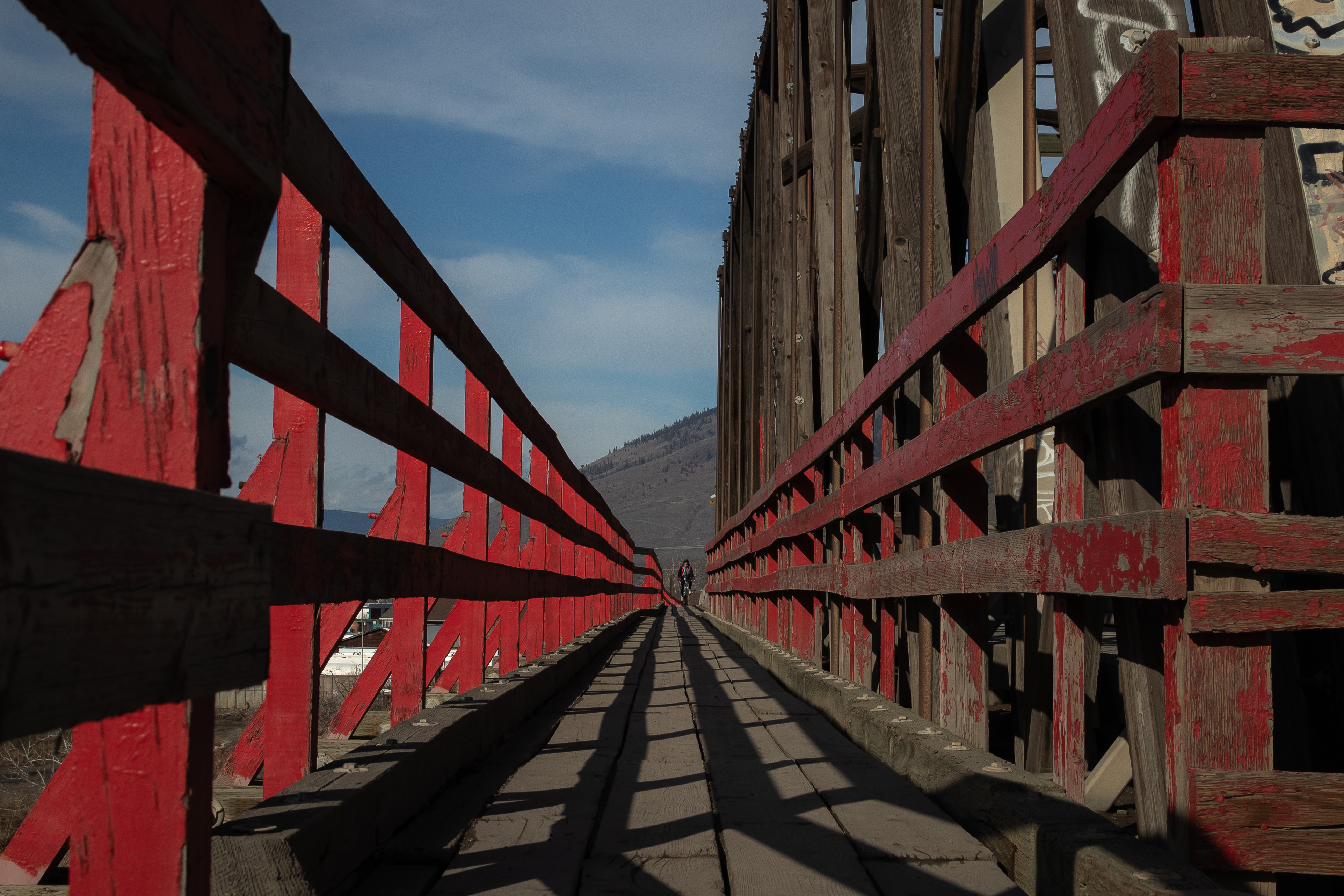
Two years ago, on Sept. 19, 2024, Kamloops emblematic Red Bridge was burned down in an act of arson after serving as the city’s iconic landmark for just shy of 90 years. Connecting more than landmass, the Bridge stood as a symbol of unity between the City and Tk̓emlúps te Secwépemc. Now, TRU students wonder what will come next for the landmark, and for the community.
Despite being a major thoroughfare for commuters, the Red Bridge connected people, businesses and communities alike. More than a bridge, it was also a significant piece of Kamloops history that had grown and evolved alongside the community. The Omega had the opportunity to talk to two long-term Kamloops residents and TRU students, Colin Forbes and Morgan Ware, who shared their memories of the Bridge and their thoughts on the long-anticipated reconstruction.
In today’s economy, picking the best route is a cost-saving measure, which is a major part of why the loss of the thoroughfare was especially damaging.
“From some of what I’ve read, [people are] arguing about whose responsibility it is to pay for it. I understand both sides, like on one side, the city says it is the Province’s responsibility. [Kamloops] doesn’t want to use our limited budget for this. But at the same time, it comes down to Kamloopsians needing access,” Ware said.
“This has impacted how I get to work, because I live in the Lower Sahali area,” Ware said. “I used to be able to go through downtown and take the bridge over to the industrial side, but now I can’t. So, A, it’s longer and inconvenient. B, gas is expensive and that’s the big thing for me, especially as a student. I don’t have the money to be spending extra on gas when I used to have a more direct route.”
The bridge was also a part of Kamloops’ history and development. Prior to the construction, the Secwépemc crossed the river using a rowboat and barge where horses swam alongside but as the city began to lay roots, so did conversations of infrastructure. Discussions to build the bridge began in 1880, necessitated by the city’s industrialization and trade between ranchers and merchants. The history of the Red Bridge is vast, with documentation of continuous maintenance and several rebuilds over the course of its near-century-long existence. In spite of strife and seasons, the Bridge stood resilient, even withstanding the flood of 1894.
“It was really sad, I’ve been in Kamloops for a long time. [The Bridge] was historic, it’s a big part of the city. You go for a walk downtown, the Red Bridge is there, Riverside Park, even Pioneer Park, like that was a big thing when I was in school,” Ware said.
A larger question surrounds the motive for the act of arson, and the perpetrator who remains unidentified.
“I remember seeing a lot of stuff on Facebook and just really horrible rhetoric and racist remarks about [the Bridge],” Ware said. “I think having connection in our community between the City and Tk̓emlúps is really important because we all live here. We should work to be more collective, but I know it’s hard when there are many voices left to be heard”.
Originally named Government Bridge, it was aptly renamed Red Bridge by locals over the course of its long life in Kamloops. The origin story of the rename is based, of course, on the characteristic colouring of the red Douglas Fir trees used in its construction which raises another question, will there be a replacement? Will it even be red?
For Forbes, the reconstruction should include a design similar to its predecessor. “[The bridge] should maybe be made out of metal, but keep the truss-style so that it still has the historical significance of the previous bridge”, Forbes said.
Since the fire, conversations have circulated surrounding the Bridge’s replacement on the municipal stage, and provincial. According to the Kamloops Chronicle, the process of rebuilding is underway as the City and Province navigate engineering the rebuild’s design and location.
“There’s plans to rebuild it. But some of those plans might just include a pedestrian bridge, not an upgrade for cars and not making it wide enough because it was too narrow before,” Forbes said. “I would at least want a wider bridge for at least one lane going either direction and maybe a pedestrian crossing but still wide enough to have cars go by without smacking mirrors.”
Attributed differently by Kamloops-locals, for some, the Red Bridge is memorialized as part of the view on a daily walk, whereas for others, it is remembered as the narrow bridge that claimed vehicular damage. Still, its loss has left a mark on the City as a firm plan for construction on a replacement has yet to be determined.