
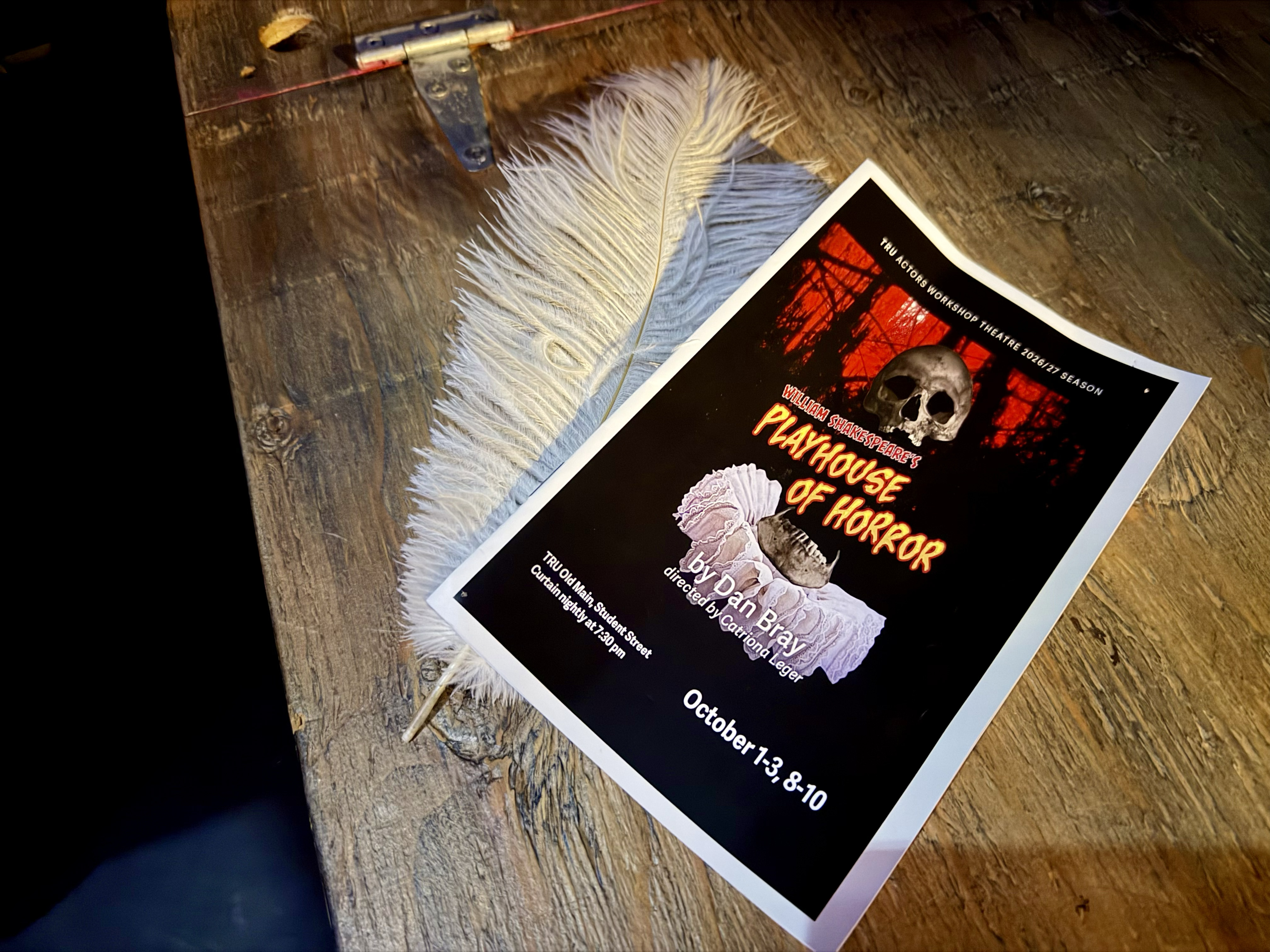
A crisp breeze is chilling the air, fallen leaves line the paths across campus, and Halloween is just around the corner. What better way to embrace the beginning of autumn than with opening night of TRU’s Actors Workshop Theatre production of Dan Bray’s William Shakespeare’s Playhouse of Horror?
Tonight at the AWT, the actors will take their marks and the audience will take their seats. But what happens before the glitz and glam of show night? Months of exhaustive preparation go into a university theatre production like William Shakespeare’s Playhouse of Horror—much of it carried out by people who will never even take the stage.
They’re the incognito figures dressed in head-to-toe black, slipping around backstage throughout the production—people you might pass without ever realizing the work they’re doing in the booth or high above the stage on the catwalks. They’re the ones you’re not supposed to see, but who deserve to be seen. Stage managers, set designers, lighting and sound operators, and many, many more—they are the unsung heroes of the theatre world, putting in countless hours to bring a production to life. The funny, paradoxical thing is that the better the technical work, the less the audience notices it.
For Jérémy Noël, TRU’s Technical Theatre Coordinator, that invisibility is part of the appeal.
“I’m happy to do it,” Noël said. “Initially, the reason why I went into backstage was because I stress way too much on stage. It’s not for me. Instead, I prefer seeing the people on stage thrive from what we make them … that’s what a technical director is.”
Teamwork makes the dream
Catriona Leger, director of Playhouse of Horror, shares a similar philosophy. She describes herself as a collaborative director, emphasizing that she is only one person among a 35-person team.
“I don’t have all the ideas,” Leger said. “No, I’m only one person. We’re a team of 35 people. […] you can’t bake a cake with only flour.”
Putting on a production is less about one person’s vision and more about figuring out how to create something beautiful and cohesive from a cluster of ideas. Noël’s role is to make sure those ideas are actually feasible — resolving conflicts between departments, working with designers and finding ways to make creative concepts physically possible.
Collaboration is perhaps the most important part of bringing a production to life. For Playhouse of Horror, that collaborative effort is larger than ever—the production has the biggest team the AWT has assembled to date. For Leger, the best collaborations are the ones where, by the end, “you don’t know whose idea was what anymore.” It is a process of listening, adapting and, sometimes, compromising, as each department brings its own expertise to the production.
The result is a show that belongs not to one person, but to the collective who built it. When asked if he could show an audience member just one thing backstage, Noël said he’d jump at the chance to show off the team; to give the audience an understanding of how many people it really takes.
‘Phenomenal production on an exceptionally tight budget’
One of the more unique aspects of a TRU AWT production is in its nature of being a classroom, itself. Noël, who teaches the theatre production class helping build the set, sees the process as an opportunity for students to learn the technical skills that happen beyond the stage. Unlike a professional production, where tasks can often be delegated knowing the person already has the necessary experience, working with students means taking a lot of extra time to teach them how to do it first. For Noël, that extra time, although stressful, is a rewarding part of the process — helping students gain the skills and confidence to eventually take on the work themselves.
Despite the abundance of collaboration, vision, hard work and creativity behind the production, there is one challenge that is difficult to avoid in a university production, and it sets Playhouse of Horror apart from larger professional productions, such as those at Western Canada Theatre: budget.
Leger notes that the AWT manages to achieve “phenomenal production values on an exceptionally tight budget.” To put that into perspective, she says the theatre’s entire four-show season operates on a smaller budget than Western Canada Theatre might have for a single production.
For Noël, navigating those limitations is part of being the technical director. Sometimes, he has to be the bad guy. In any production, he said, there comes a point when the team has to decide whether an idea is worth the cost — whether to spend $500 on one element or use that money to create seven others.
Those decisions are part of making the impossible possible: figuring out how to turn ambitious creative ideas into something that can actually be built, lit, sounded and performed.
‘A theatrical speedrun’
Noël and Leger describe the production schedule as a kind of theatrical speedrun. The four productions for the year are shortlisted by the directing team in January. Once Playhouse of Horror was selected, the production team was established in April and went into high gear in early July. Much of the set-building team — as well as the actors — are students who don’t return to campus until September. From there, the process is streamlined toward opening night.
After months of preparation, the production crew enter tech week — a labour-intensive stretch of marking and cueing designed to iron out the show’s remaining flaws before opening night. After entire days of classes, work and extracurriculars, the team spends five-plus hours each night in the theatre. For a team almost entirely built of students and professors, that’s quite the feat!
For stage manager and recipient of the 2025 TRU AWT Technical Theatre Award Madeline Bayliss, the workload extends far beyond those hours in the theatre.
“When you work on a show, it is like a class and a half,” Bayliss said. “It’s, for me, as a stage manager — and I know for the actors too — it’s outside work as well.”
That outside work includes sending rehearsal reports, creating daily schedules and coordinating headshots, makeup meetings and costume fittings.
The audience will see the polished, finished product, but what they won’t see are the months of planning, the late nights, the budget decisions, the technical problem-solving and the hundreds of small adjustments that have to happen before the curtain rises.
Leger compares the work happening backstage to a duck moving across the surface of the water: calm and collected above, with its feet moving rapidly underneath.
“It is a dance back there,” Leger said. “Just how quickly everything moves and the way in which it needs to flow.”
Behind the polished perfection the audience sees on opening night is that dance. And tonight when the lights go down, the actors take the stage and the audience settles into their seats, there is excitement — and peace — in knowing the people backstage have done their job well enough that you might never notice they were there at all. Leger describes opening night as the saddest part of her run as a director, a bittersweet combination of pride in watching everyone’s hard work pay off, while also knowing that “her work here is done”.
William Shakespeare’s Playhouse of Horror runs Oct. 1–3 and Oct. 8–10 from 7:30–9:30 p.m. at TRU’s Actors Workshop Theatre — come take your seat, and see the finished product of all the work that happens behind the curtain.