
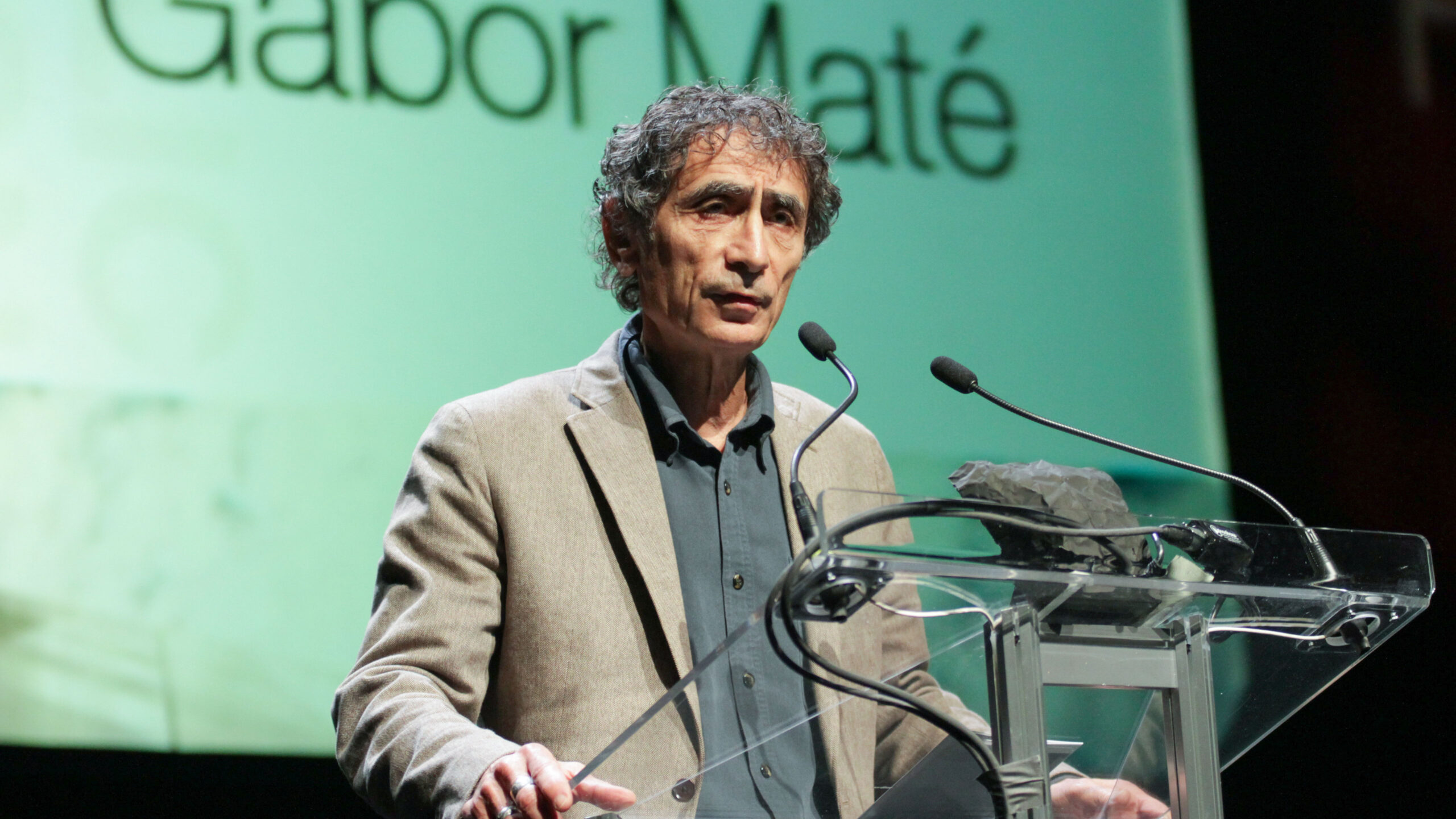
Physician and bestselling author Dr. Gabor Maté spoke to a packed crowd of students, staff, faculty and community members in the Grand Hall at the Campus Activity Centre on Feb. 11. His talk, which addressed the social and biophysical conditions of addiction, aimed to broaden common understandings and correct general misconceptions about substance use and addiction.
The event was part of TRUSU’s Common Voices lecture series, which has been running for 2 decades and has brought internationally recognized thought leaders to the TRU campus.
Maté opened his lecture by addressing the recent tragedy at Tumbler Ridge, describing the perpetrator as a “young woman” with a “mental health history.”
“What I can tell you with 1,000 per cent assurance and confidence, without knowing anything about her,” he said. “Is that she was a traumatized person. Because trauma is the basis of mental illness.”
He also addressed what he saw as the hypocrisy of land acknowledgements in a nation that too often undermines Indigenous sovereignty. He pointed out that, despite making up just 5 per cent of the Canadian population, Indigenous women are severely overrepresented in the justice system, witharound 50 per cent of female admissions in federal corrections.
“Where is the reconciliation?” Maté pondered.
His 12-year stint in Vancouver’s Downtown Eastside gave him a unique perspective on the ‘drug crisis.’ An area of particular focus in the substance use epidemic facing the country, the Downtown Eastside also has the highest concentration of Indigenous people in the city, with around 31 per cent of its population made up of Indigenous people from all across the country.
“If the success of a physician is to be measured by the health of his patients, I was a total failure,” Maté said. “Because my patients died of their overdoses, they died of HIV, of infections caused by injection use, hepatitis C, abscesses in their spines, loins and brains, of suicide, of violence. Crossing the street in a drunk haze and being hit by cars.”
Though the area has only gotten worse since he left in 2011, Maté does not see this as a problem with the Downtown Eastside. Instead, he sees these issues as problems of the Canadian state—inadequacies of social support that drive people to substance use issues, addictions and dependencies.
Maté, throughout his talk, challenges certain myths around addiction. A major one was the idea of addiction as a choice.
“The whole legal system is based on this approach to addiction,” Maté said. “That it is a choice people make, for which they are culpable and need to be punished. So, for some reason, these Indigenous people are just making bad choices, you know? Which incidentally seems to be true not only here in Canada, but in all colonized countries.”
This common assertion, Maté said, has zero scientific evidence behind it. Yet it has significantly influenced policy and policing practices in the Western world.
He points to the failure of the “Just Say No” campaign championed by Nancy Reagan, then-first lady and wife to United States president Ronald Reagan, as well as the history of alcohol prohibition. In each of these cases, he said, choice-based understandings of addiction created inadequate responses.
To illustrate his points, Maté was brutally honest about his own history of ADHD, his childhood trauma as a Jewish infant during the holocaust and his shopping addiction.
“The addictive brain is fantastic when it comes to self-delusion, sophistication and rationalization,” he said. “There were some holes inside me that I wanted to fill, and I was just as scrupulous and dishonest as my patients in the Downtown Eastside.”
For Maté, every individual who develops an addiction, no matter what it is, is doing so in order to fill these holes. In the section discussing opioids, he addresses the history of opioid use in pain management that stretches over thousands of years. Today, he says, is no different.
“Pain is essential,” he told the crowd. “What do you call somebody who is drunk and says that they’re feeling no pain? That is my [view] on addiction. Don’t ask why the addiction, ask why the pain.”
Maté took questions at the end of his talk, ranging from issues of public safety, support, and healing to the ways trauma can be passed down from parent to infant. As the event closed, guests rushed outside to purchase signed copies of Maté’s latest book, The Myth of Normal.
To learn more about Maté, his accomplishments and where to find his work, visit his website here. You can also go to TRUSU’s webpage to keep abreast of the next Common Voices lecture, or any of the other programs offered by the Students’ union.