
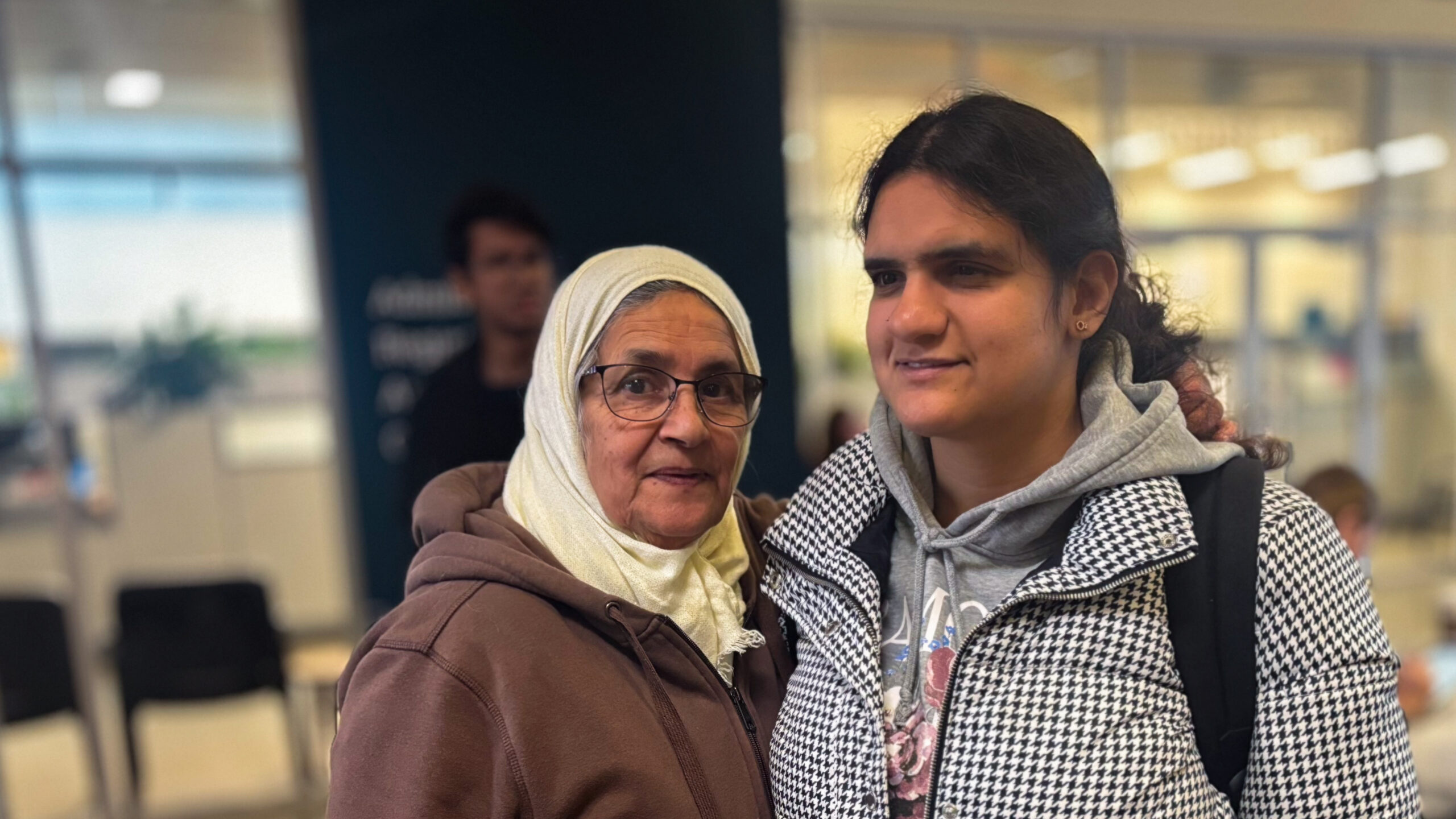
“Accomplishing my goals would mean letting go of my fears, because all of us have fears at the end of the day,” shares TRU journalism student Nada Abdelghaffar with a hopeful heart, as her mother sits supportively by her side.
In 2017, Abdelghaffar landed in Kamloops carrying more than a suitcase; she carried the courage to step off familiar ground into the unknown. Born in Cairo, Egypt, with congenital glaucoma, Abdelghaffar has spent her life navigating a world that often wasn’t built for her. Coming to Canada was more than a change of scenery; it was her first real step toward letting go of fear, a leap into a life where accessibility, independence and belonging might finally take root.
Abdelghaffar’s story is one of growth and self-discovery, as she learns to redefine herself while adapting to a new culture and advocating for herself.
“I started to notice I was blind when my brother was three years old,” Abdelghaffar recalls. “When we ran through the house, he could catch a ball faster than me and that’s when I realized I was different.” She didn’t always know she was born with a disability; her understanding came gradually, “by time,” as she puts it. It was when she was six years old that she fully grasped the reality of her condition – she watched her classmates learn to read and write through print while she learned braille.
One of Abdelghaffar’s first challenges growing up was finding acceptance among her peers and society while wrestling with her own internal conflicts. Regarding work experience, she shares, “I was accepted at several companies, but once they realized I’m blind, they kept drawing back.”
When asked if she had ever faced moments of lost determination, her response comes quickly and firmly: “Yes.” Then, after a pause, her voice softens. “One of the moments I cannot forget is when I heard some of my classmates in Egypt say, ‘let’s organize this gathering and invite everyone else but not invite Nada’.” She recalls that she was later invited to the party but then refused without hesitation. “Do not make amends for something you can’t fix,” she told them.
While Abdelghaffar tells this story, her mother, Nadia Khalifa, sits beside her and listens closely, nodding in quiet, solemn agreement. Occasionally, she reaches over to smooth her daughter’s jacket, her hands moving with the ease of a protective mother and her eyes scan instinctively, as if able to sense what her daughter might need before she says a word.
Over time, Abdelghaffar decided to move past not only social barriers but also the accessibility restrictions in her hometown. Her mother was one of her strongest supporters. In Egypt, resources for people with visual impairments are limited and accessibility is often overlooked. At school, Abdelghaffar relied on someone to read her exams aloud, which became especially challenging during mathematics tests. Sometimes, the person assigned was from a younger grade and struggled to read numbers and symbols accurately, making the experience even more difficult.
As Abdelghaffar grew and pursued higher education, new challenges emerged. When admitted to the Faculty of Law at the University of Cairo, both she and her mother had to navigate an education system that wasn’t designed with accessibility in mind. According to UNESCO, students with disabilities in Egypt face systemic barriers to education, including shortages of trained staff and limited access to materials in Braille. “I used to read Nada books in both English and Arabic,” Khalifa says. “Some of them were law subjects and it’s hard for someone outside the field to interpret and read those words.”
The decision to move to Canada was both a hopeful step and the beginning of new challenges. Shortly after settling in, Abdelghaffar’s plans took an unexpected turn when the COVID-19 pandemic forced her return to Egypt. Leaving Canada felt like pressing pause on the independence she had just begun to build. It was a similar experience for many international students who needed to return to their home countries during the pandemic. But when borders reopened and life slowly stabilized, she returned to Kamloops, determined to continue what she started.
“The move required Nada to be brave so she could build a life and education more easily,” her mother says. “We were very worried at first, but over time we began searching for the resources she would need to adapt to life in Canada.”
In Kamloops, the CNIB (Canadian National Institute for the Blind) connects people with vision loss to orientation and mobility training. This program teaches skills for safe and independent travel, using a white cane and spatial awareness techniques. When Abdelghaffar first arrived in Canada, she had never walked alone with a cane, nor had she received any formal mobility training. This became one of her first real encounters with structured accessibility.
The program estimated it would take around four years to complete. At first, she worked through the training on her own, but when Khalifa arrived from Egypt to support her, they began practicing together, sometimes until two in the morning. With that dedication, the journalism student mastered the skills in just a few months.
Through the hallways of Thompson Rivers University, Abdelghaffar moves confidently with her cane, her mother walking beside her – part guide, part silent support, part witness to her growing independence. At one point, her mother lets her go, keeping a careful distance as she watches her daughter navigate the crowded aisle toward her classroom with focus and determination.
In the classroom, the determined Egyptian girl finds her seat each day, feeling every table until she reaches it. Using a VoiceOver feature on her computer and professors’ descriptions of slides and images, she engages confidently, asking questions, responding thoughtfully and was one of the first students to volunteer for improvised presentations. Abdelghaffar’s resilience is matched by a gentle warmth.
Her strength in expressing her beliefs and feelings is noticeable, even when it places her in a vulnerable position. “Sometimes it’s not easy and sometimes I hate that I am blind,” she admits with a soft tone. “But I try to make something good out of it and challenge myself. It’s something I cannot change and if you don’t try to live with what you have, you’ll lose it.”
Her determination extends beyond the classroom: during a TRU visit in January 2019, she asked then-Prime Minister Justin Trudeau how government meetings could be made accessible for the visually impaired. He asked for her contact information to follow up with her query, an experience Abdelghaffar calls the moment she felt most proud of herself.
Throughout our conversation, Abdelghaffar, with her dark hair in a low ponytail and soft expression, reaches out to my hands across the table and rests her fingertips lightly on my hand, a quiet way to anchor herself in the moment and stay connected.
When I ask Khalifa what she’s learned from her daughter, Abdelghaffar laughs, leans towards her mother and says, “I am the crazy rebellious person, that is what she learned from me.”
Khalifa describes her daughter as patient, brave and a person who tries hard. By watching her daughter, Khalifa says, “I learned the resilience to accomplish goals and do whatever it takes to achieve your dreams.”
A reflection of a journey defined by courage, independence and the refusal to accept limits.
When I ask Abdelghaffar what she hopes people take away from her story, she replies, “I hope they can take inspiration, resilience…” then, with a small laugh, she adds, “and rebellion. Don’t always accept what’s on the table.”
Nada, what an inspiring read. Your grit, independence and the way you’ve backed yourself every step of the way is seriously impressive. You don’t let limits define you, and that takes real courage. Proud of you, keep pushing forward and all the very best with what’s ahead.
Mashallah Nada, your strength and courage are truly inspiring. Reading your story filled me with pride, and I would be honoured to share your journey with my daughter, my family, and my wider community here in the GTA. Your cousin Sherif is a dear friend of mine, and he always speaks of you with great respect and admiration.
May Allah Subhanahu wa Ta’ala bless you, guide you, and open every door that leads to the fulfillment of your dreams. Keep shining—your resilience lights the way for so many.
Life is a long journey and the smart person must cross the parking stations and pass them to reach the goal.
Go ahead and complete your amazing journey.
Nada is very inspiring. I know her on a family level she is very rebellious however she is a very strong fighter. She gives up sometimes but her mother Nadia khalifa is always backing her up opening doors for her to always have hope. Nada sees the light through her mother Nadia khalifa.
I’m lucky to know Nada and aunt Nadia in person – this article only recaps a very small portion of what their story is, such an inspiration for the ages!
Reading this made my heart so full.
You are strength, courage, and determination in human form. So proud to be your cousin. Keep shining, Nada. will always be proud of you!!
Nada, your courage is inspiring. You turned fear into strength, built your independence step by step, and refused to let any barrier define you. Keep going, your resilience and “rebellion” are changing what’s possible.