
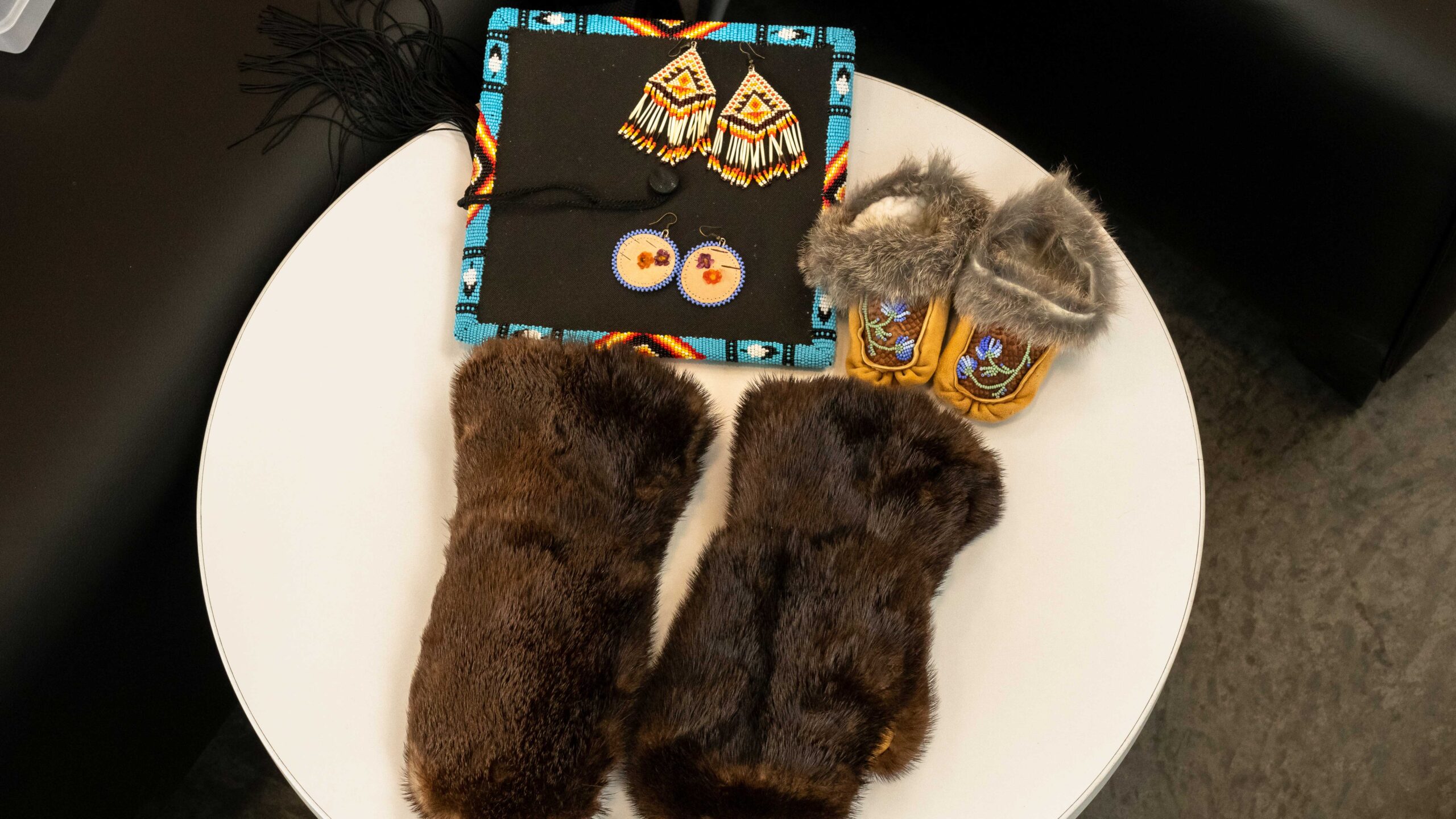
Jess Owen comes from a long line of creatives. Speaking with the Omega last week, the Natural Resource Science professor shared how she finds balance between art, community, and academia.
Hailing from parts of central and eastern Canada, her family has long been connected to the land. “My mom grew up in the bush,” she said, recalling her mother’s stories of growing produce and raising cattle, with single 100 lb. bags of flour and sugar being some of their only food purchases for the year.
This self-sufficiency fostered creativity, as making and sewing clothes was a key part of the family’s support.
“My grandmothers and aunties have all been amazing artists and seamstresses,” Owen said. “They made [alot] their own stuff.”
She highlighted the importance of these practices for cultural connection. “I just did a big bead project where I was really thinking about my grandmothers, and feeling some of their energy from the art,” she shared. “It’s like generational muscle memory.”
The Métis are renowned for their stunning beadwork, often featuring bright floral motifs. In her practice, Owen not only follows in the long history of Métis artists but also joins a vibrant group of contemporaries, including Lisa Shepherd and Jennine Krauchi.
Utilizing materials from the land, such as birch bark and deer hide, Owen crafts intricate pieces of traditional clothing. Her works feature fish scales shaped into flowers, porcupine quills reimagined as the base for elegant, beaded earrings. Echoing her family’s resourcefulness, she said a dream project would involve making everything “from start to finish,” without any purchased materials.
Despite the time and care she puts into her projects, Owen emphasized she wants to see them worn. Some of her family’s works are on display at a museum in Batoche.
“It’s interesting seeing their stuff behind glass,” Owen explained, adding that she wouldn’t want her own work kept out of reach. “It’s meant to be held and touched and felt.”
When she’s not teaching on campus or studying for her PhD, Owen dedicates her time to the Two Rivers Métis Society, where they offer workshops in hide tanning. “It’s one of the best classrooms,” she shared. “Sitting around a hide with elders and knowledge holders… you’re hearing their stories and they’re passing on information.” She highlighted these circles, whether for hide tanning, beading, or sewing, as a valuable opportunity for connection with others.
Given all her commitments, Owen said it can be challenging to maintain her cultural practices. “[It’s] probably a very common experience for Indigenous academics because you’re going in so many different directions.” She conveyed the importance of learning to hold boundaries and say ‘no’ to things. “I’m still learning,” she said. “I’ll be learning my entire life.”
Looking forward, Owen said she’d like to incorporate art in her teaching and deconstruct the colonial view of the classroom. “I think students have so much to teach as well… I want to open up that space for dialogue. That’s something I aspire to do.”
Readers interested in Owen’s art can follow her beading page on Instagram here.