
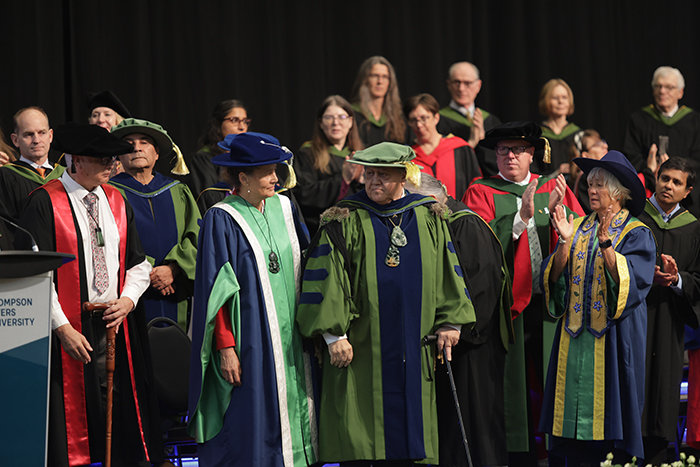
At TRU’s Fall Convocation ceremony, Dr. Graham Hingangaora Smith received an Honorary Doctor of Letters for his work in transforming post-secondary education for Indigenous and Māori students in Canada and New Zealand.
TRU presents Honorary Degrees to individuals who have made significant contributions, both within and beyond TRU, in the fields of public affairs, sciences, arts, humanities, business or philanthropy.
The Fall Convocation ceremony took place on Oct. 9, 2026, and welcomed Smith to accept the degree and address the graduating class. In his speech, he stressed the importance of Canada’s global influence in striving to build a more just society. “Many of us across the rest of the world notice Canada’s steadfast pursuit of humanitarian ideals, its resistance to diplomatic intimidation and to advocacy for peace,” he said.
To close his speech, he invited the audience to become positive and proactive transformers of the world around them. “We cannot afford to keep waiting, to keep thinking about how we might react, to keep hoping someone else will come up with the answer, to keep relying on others to lead,” Smith said. “Everyone must become a leader.”
Smith’s impact on education began in his home country, New Zealand, where he helped popularize Kaupapa Māori Theory, a method centring traditional Māori knowledge, language and practices. This decolonized way of learning allowed Indigenous students to succeed academically while maintaining their cultural traditions.
In 1997, while earning his PhD at the University of Auckland, Smith’s thesis, The Development of Kaupapa Māori: Theory and Praxis, became the foundational text outlining the theory and its principles. As Smith mentioned in his speech, “we should never forget our history, but we must use it as a lever to learn, to build and to transform our hopes.”
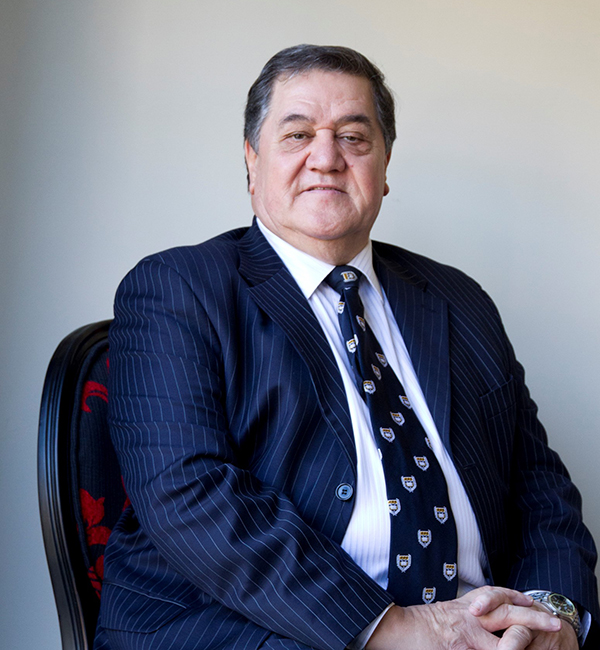
Smith’s influence extended to TRU and the Knowledge Makers, where he has mentored students since the program began. The Knowledge Makers program teaches undergraduate Indigenous students how to conduct research and publish peer-reviewed journal articles. Similarly to Smith’s work, the program values Indigenous knowledge in academic research. An alum of the program was Marie Sandy, TRU’s manager of Indigenous student services.
“I find that a lot of people who have gone through the Knowledge Makers program have gone on to actually do more education because they understand that research is just diving into knowledge systems that we already understand and can bring forth,” Sandy said. “It helps promote that Indigenous knowledge is very valid and it’s here to stay.”
Throughout his career, Smith has challenged traditional education methods and taken action to build new research networks. Having advocated for Indigenous students’ access to higher education, Smith founded the Māori and Indigenous Doctoral Program, which saw over 500 Māori PhD graduates within seven years. He has also helped establish New Zealand’s Māori Centre of Research Excellence and the Indigenous Education Institute of Canada at UBC.
Smith’s influence can already be seen in TRU, including a direct mentorship for President and Vice-Chancellor Dr. Airini. According to Sandy,
“I think the fact that we have so many Indigenous academics is already the direct impact that we have seen from Dr. Graham Smith,” Sandy said. “If you get to know him, he has touched base all over the world and encouraged Indigenous researchers in all Indigenous spaces all over the world. He has had a huge impact on Indigenous research and Indigenous academia.”