
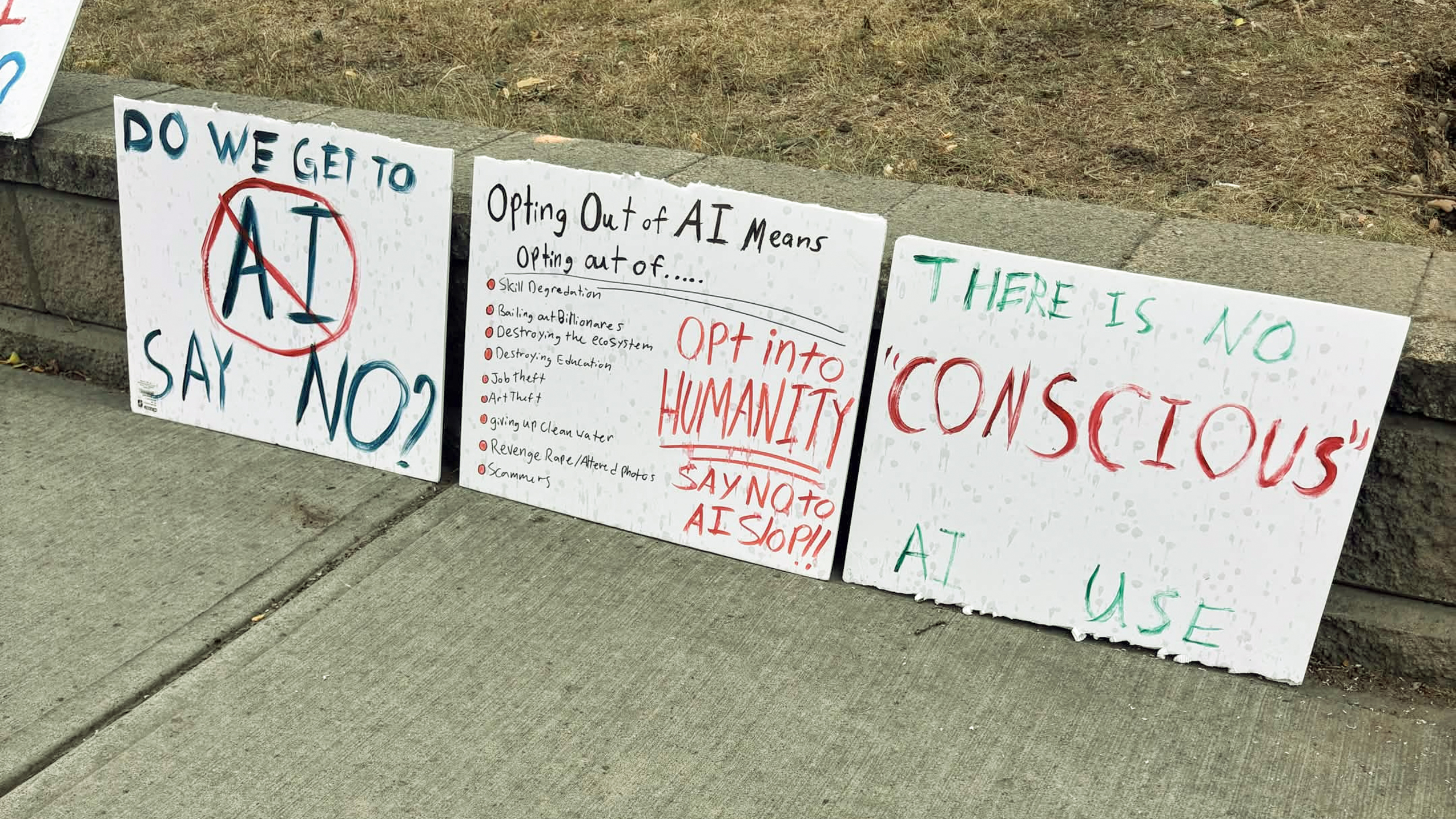
The construction of AI data centres within Kamloops has garnered mixed responses, with the City claiming it is necessary for the growing demands of businesses, researchers and public officials. Alternatively, many believe the construction is unnecessary given the environmental consequences. On June 27, local activist group Slop Stoppers orchestrated a gathering at the City’s courthouse in protest of the current construction of AI data centres in Kamloops.
Conversation surrounding AI sovereignty has been ongoing within the Government of Canada, namely, The Canadian Sovereign AI Compute Strategy (CSACS). The CSACS was engineered to strengthen Canada’s economic growth as a leader in AI technologies. According to the Government, the CSACS will be implemented in two stages beginning with a $700 million investment that will be allocated to the creation of a faster compute capacity, designed to meet the needs of Canadian businesses and academic institutions. The second phase will then include the physical development of AI infrastructure, such as data centres, projected to receive an investment of $1 billion.
Since the rapid proliferation of the technology, the presence of AI has brought forth mixed responses including among the community at TRU where data centres are being built in collaboration with major Canadian tech titan, Bell Canada Enterprises. Kamloops will soon be a featured location in housing not just one, but two, data centres, along McGill Road.
Such rapid advancements in infrastructure comes as a stark transition given TRU’s reputation as being an environmentally motivated research institution. According to the university’s administration, advancing the necessary technological ecosystem will come as a benefit and cites sustainability as a priority. The company who is tasked with the engineering and development, TrueNorth Sustainable Infrastructure Inc., is also an alleged sustainability advocate. Their selling feature is a promise to deliver AI infrastructure that has a lower carbon footprint of 35 per cent compared to traditional datacentres. Still, advocates such as Slop Stoppers organizer and recent TRU graduate, Gouda Mourning, contends that the environmental disruption compounded with noise pollution is of significant concern.
“[There has] been a noticeable pattern of data centres being built [within] communities that are prone to drought and wildfires that use up our resources. There’s a claim by people who are pushing for these data centres that they are sustainable and that they have a closed loop system. There [have] already been drawbacks, as we can see in the States,” Mourning said.
The intricacies of data centre mechanics are vast, and continue to rapidly unfold. Compared to traditional data centres which often rely on air-cooling systems, AI data centres require more energy, and rely extensively on natural resources such as wind and hydro-power. TRU President Airini has stated that residents of the city need not be concerned by AI data centres as they will operate on a closed loop system that will rely on recycled water. Moreover, in an article featured on CBC, Airini has claimed that noise pollution is of little concern but rather the infrastructure is substantially quieter compared to others due to a lack of cooling fans. Apparently, the data centres will be no louder than a lawnmower.
“TRU is thrilled to combine our world class standing in environmental sustainability with the vision and actions of Bell AI Fabric to achieve exceptional AI network capabilities. We are convinced the way forward is applied and responsible AI,” said President Airini as part of the Thompson Rivers Community Trust (the Trust) in commencing construction.
Pledges toward sustainability have since been received with skepticism. It comes as no surprise that TRU is one of the many Canadian post-secondary institutions who have suffered from decreased enrolment and budgetary limitations. Amidst financial concerns, post-secondary enrolment has decreased as made evident by decisions to suspend programs with low enrolment such as the Visual Arts program and discussions of limiting student services such as the Writing Centre. For protestors, It is evident that the impacts of AI technologies and infrastructure are not limited to concerns for the environment, but also have a social impact.
“The consumption of water has been [huge]. The mental and social impacts are hurting everyone. We just want to promote humanity,” Mourning said. In fact, Mourning was one of the engineers behind the protest and was inspired to take action following the cuts to the visual arts program. “[The data centres] feel very insulting. I recently graduated with my certificate in visual arts and there was a whole speech at our graduation about how great and sustainable TRU is, and how the programs we graduate from have value in the workplace. I almost wanted to say, ‘If my program is valued then why did you cut it?’” Mourning said.
Saturday’s peaceful protest brought forth a sizable group of individuals with equally distinct and formidable causes, from the social to environmental impacts. Among the crowd was a delightful mix of school children, willing to sacrifice an afternoon so that they could protest alongside seasoned post-graduate academics and advocates. For some, the support of AI technologies is a troublesome presence in education.
“[AI] is contributing to the massive literacy crisis that is going on within Canada. The reason this is happening is because of large corporations who want this to happen. [They] want us to stop thinking critically about the reality of class society. Only through education, literacy, and critical engagement will people be able to actually think about the world around them and make a change” said James, a student and fellow protester.