
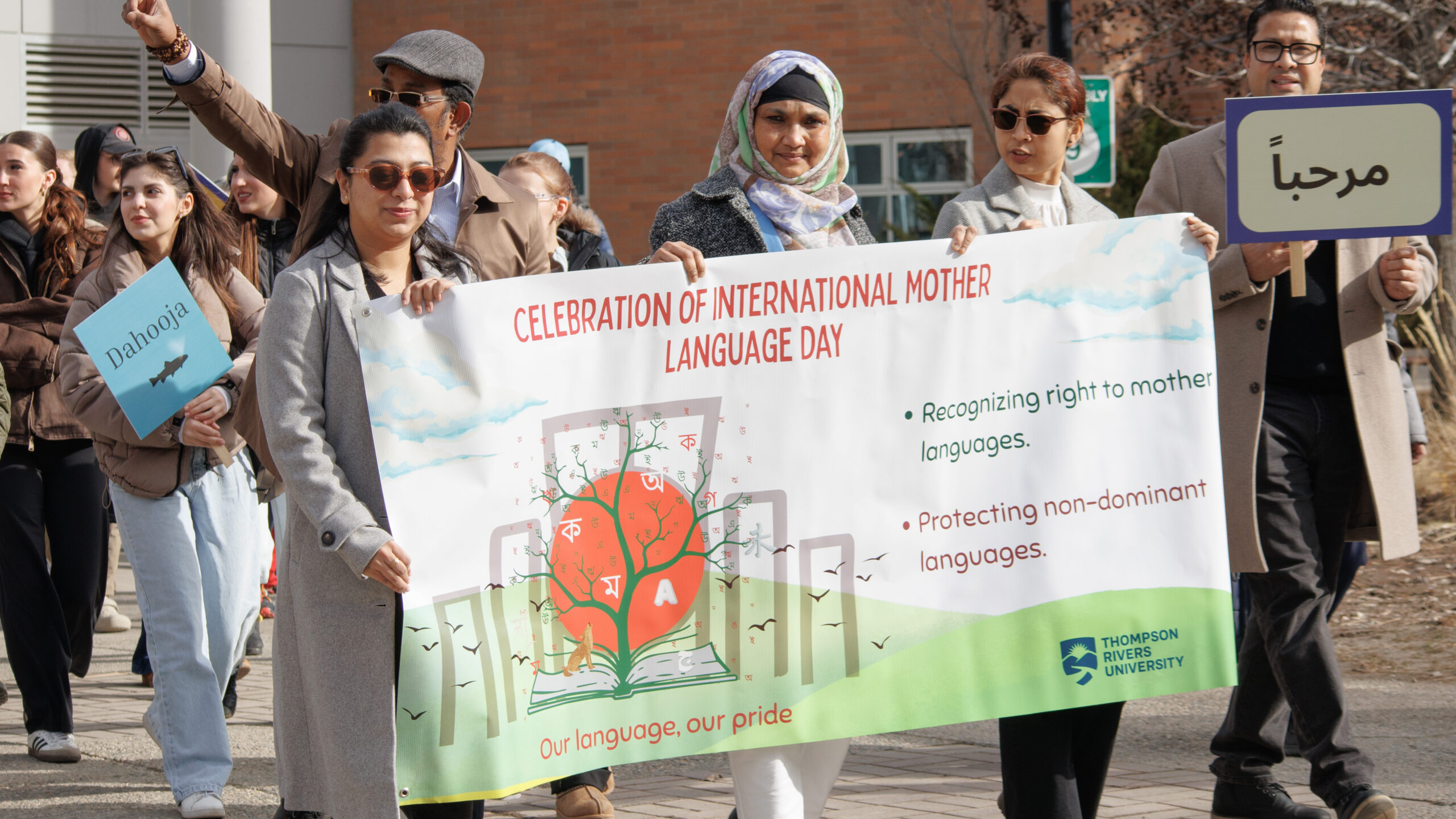
Dhaka, 1952. University students protested their government’s decision to make Urdu the sole state language of East Pakistan, now Bangladesh. They sought the recognition of Bangla (Bengali), the majority’s mother tongue, as an official language. Many were injured in conflict with the police, and several students, now known as the Language Martyrs, were killed.
The anniversary of this tragedy, Feb. 21, has long been recognized as Language Martyrs’ Day in Bangladesh. In 1998, Bangladeshi-Canadian activist Rafiqul Islam wrote a letter to UN Secretary-General Kofi Annan asking for the issue to receive global attention. Now, Feb. 21, is observed worldwide as International Mother Language Day (IMLD).
On Feb. 23, the TRU community gathered to commemorate IMLD. The event began with a march and concluded in the Campus Commons, where speeches were held.
“This is not just a day on a calendar,” Bangladeshi professor Musfiq Rahman told the crowd. “It is part of who I am. It is woven into my identity, my culture… For our people, this was not just a political dispute. It was an attack on our very soul. Bangla is the language for our poetry, our music, our mothers. It is how we express love, grief, joy and everything in between.”
Rahman, along with fellow professors Ehsan Ahmed and Humayun Kabir, led the event planning. It was also supported by the Office of Indigenous Education; TRUFA Decolonization, Reconciliation, and Indigenization Staff Committee (TRUFA-DRISC); TRUSU Bangladesh Club; and the President’s Office.
IMLD resonates strongly in Kamloops, where language-based oppression has led to the endangerment of the Secwépemctsín language.
“Secwépemctsín, like so many other Indigenous languages across Canada, suffered deeply under colonial policies that punished children and put them in residential schools for simply speaking in their mother tongue,” Rahman said. “Today, 98 per cent of Indigenous languages in North America are endangered. The parallel with 1952 is real, and it is powerful. Just as students in Dhaka stood up and said, ‘language is our identity, and we will not surrender it’, the Indigenous people here are saying the same thing today, and we are gathered here to respect that and show our solidarity with them.”
“When I think of language, I think of where I come from,” said Garry Gottfriedson, Secwépemc special advisor to the president. “My people say our language comes from the land. The sounds that I know from my language come from this land here, Secwépemcúl’ecw, and they’re the sounds of my ancestors. I carry that within me, as do you.”
“When you come here, you bring a part of your land, you bring your ancestors,” Gottfriedson added. “And my people have always welcomed people into our land. To hear the sounds from your people, to hear the sounds of your ancestors speaking through you, is a beautiful thing.”
In her remarks, President Airini underlined the role of students and universities in the fight for language rights. “We’re remembering events of 1952 in Dhaka and those who passed because they were demanding the right to speak and learn in their mother language,” she said. “And it was students who demanded that right.”
Airini added that TRU is committing to supporting mother languages “in action, not just in words”, including by planning to offer Secwépemctsín at the “degree level.”
Staff members Keisha Morong and Gabriela Jimenez both attended the event in solidarity.
“I’m here because I think everyone has the right to who they are,” Morong shared. “Mother language is such a big part of our identity and our families. I love any chance we get to celebrate the depth and the history of who we are as people.”
Morong added that she hopes the event prompts English speakers to recognize that many peers and community members have other languages as their mother tongue.
“I hope that people take away the fact that you have the right to exercise your language no matter where you are,” Jimenez said. “And it’s so beautiful expressing [yourself] in your own language, even if other people don’t understand that.”
Event organizers hope that TRU will continue to recognize IMLD in the years to come.
“It’s a motivation to continue speaking all of our languages here on campus,” explained Mixalhíts’a7 (Roxane Letterlough), associate professor and TRUFA-DRISC co-chair. “I think it’s extremely important that we honour where we come from. The languages that our mothers speak are very powerful. And if we don’t have that opportunity, especially in a learning environment like this where many students are distanced from their home communities, this is an opportunity to be recognized.”