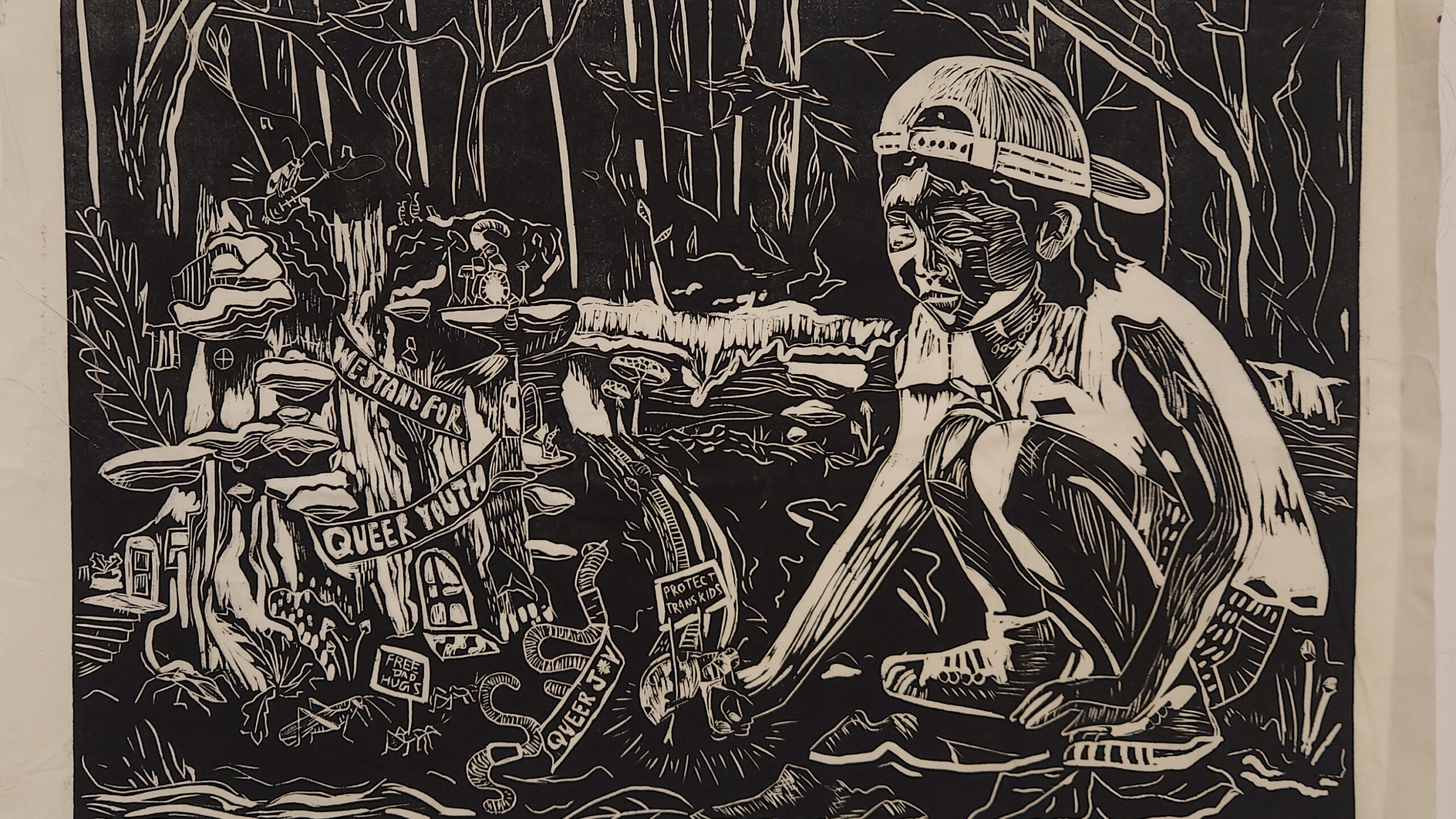
TRU’s art gallery’s current exhibition, (Re)awakening Our Own Stories by Alana Norie, honours the connection between the land and 2-spirit, queer, and trans youth through art-based storytelling.
The project started as research for their Bachelor of Interdisciplinary Studies program. After receiving a grant from UREAP, an undergraduate research apprenticeship program, Norie approached the project from a community-based perspective. The project started as an academic inquiry into research themes.
The themes investigated relational agency and how non-hierarchical leadership relates to our relationships with other beings, where queer storytelling is an act of joy and resistance and seeing land as a cocreator rather than a backdrop. The art in the exhibition was created as an extension of the stories told throughout the research process, to communicate the findings from their 80-page thesis.
“I think a lot of research is really inaccessible, especially when it’s outside of your discipline. For me, going in with the values of community-based research and art-based research [there was a question of] how can this research serve the community, but also for the people outside of it, how can they access it in a really tangible way? I think art is a really visual and accessible medium for people to access academic research,” Norie said. “I think more than ever, we need to engage in research that goes beyond Western ways of knowing, and really rigid ways of knowing and binary ways of knowing. If I’ve been taught anything, there are so many avenues to do that, but art is a really solid one.”
As a part of the research, from June to Sept. 2025, Norie conducted interviews with 12 participants who have been involved with camping organizations and programs that support queer, trans and 2-spirit youth. These included CampOUT!, Camp Huckleberry, Qmunity Camp NWT, Out on the Land and Camp Kin. The interviews with counselors, facilitators, mentors and former campers showed the important relationship between 2SQT+ people and the land. At age 18, Norie attended UBC CampOUT!, which they discussed at the exhibition’s opening.
“When I started to brainstorm what would be the beginning of a two-year research project, I knew one thing really genuinely. I knew that the magic that I witnessed at land-based camps and offerings for 2-spirit, queer and trans youth was one of the most transformative things I’d ever experienced,” Norie said. “The experiences that I had there as a youth and as a leader are indescribable. They’re the ones that make you see a bright future… They’re the ones that make you realize that there is such profound joy in the world.”
Norie has since become a mentor and co-facilitator for the CampOUT! Program. Numerous pieces in the exhibition recall backpacking trips Norie has led for trans and queer youth. A watercolour comic strip tells the story of a five-day backpacking trip. One of the panels depicts a camper swimming for the first time in years, being in a space where they can feel safe and at ease with their identity. Norie noticed this freedom during their first experience with the program.
“I remember at that time being a recently out trans youth, and going to this space where people could just exist in their bodies,” Norie said. “The land is a space where diversity is abundant. No two ferns are the same. No two barnacles are the same. Nature itself is not binary. I think that allows queer youth to see themselves in a way that urban societies don’t necessarily represent.”
The exhibition uses a wide range of mediums, including paint, textiles and photography, helping each piece be uniquely rooted in storytelling.
“The research and the art is expansive and meant to meet people where they’re at, and I think multiple mediums [do] that. It allows stories to be told in different ways, but also for people to access those stories in different ways. We all go into the gallery and gravitate towards something, and that is a really individual experience,” Norie said.
Through this exhibition, Norie not only expresses themself, but also provides a platform and invites others to do the same. The deeply collaborative process is reflected throughout the exhibition, with other artists’ work and writing being displayed alongside Norie’s. One wall in the gallery prompts attendees to think of a future they hope to see, write that dream on a sticky note and place it on the wall. Many of the pieces reflect the idea of sharing stories and community connection as a means to construct the future we dream of.
“I think the nature of those programs and how they collaborate with the land was inherent and always existing, so I think to make art about that requires collaboration,” Norie said. “I also think that my own voice could not even begin to capture the magic of what happens in those spaces. I feel that it was a gift that I was given from all these people, to have their voices in there, to have their art in there, because I don’t think I could tell the story otherwise.”
The exhibition will be displayed in the TRU Visual Art Gallery until March 25, 2026.