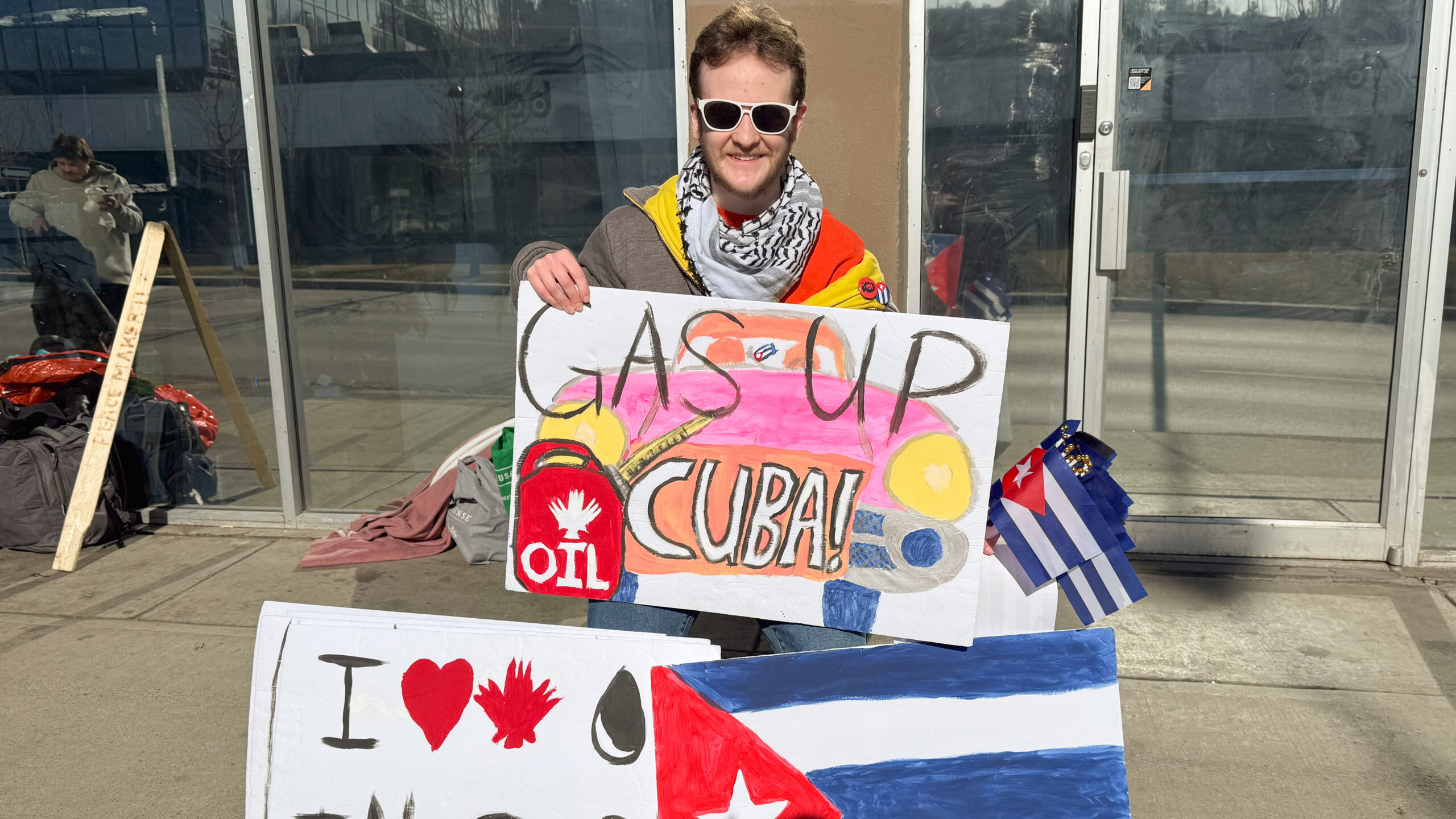
One lone individual, holding several protest signs and a handful of Cuban flags, stood across the street from City Hall on Feb. 28, seemingly unfazed by the odd stares he drew from passersby. His name is Jimmy Lokken, and though his attempt to organize a protest against the United States economic blockade of Cuba did not go as planned, his resolve remains strong.
“I’ve been trying to write to MPs,” Lokken told The Omega. “Obviously, there’s a lot to write about. But one thing I was hoping to do is organize a march directly to City Hall to, hopefully, show that we need aid to be sent to Cuba.”
Unfortunately for Lokken, the protest sputtered to an end before it could even begin. Riverside Park, which was supposed to be the march’s take-off point, was empty save for a few dog-walkers and the early signs of a children’s birthday party. And City Hall, where the main demonstration was planned, sat quiet and undisturbed.
Lokken was spurred to action by the recent United States-led oil blockade and subsequent energy crisis in Cuba, which has caused severe disruptions in the lives of the 11 million inhabitants of the Caribbean island. The nation’s current plight began after the abduction of Venezuelan President Nicolás Maduro. As Cuba’s closest ally in the Western Hemisphere, Venezuela had been supplying most of the republic’s oil. Now, the United States is making several moves to strangle the Cuban economy through the restriction of oil trade.
Not only is Cuba’s main oil supply from Venezuela now effectively cut off (and the United States President Donald Trump’s administration has vowed that it will remain so), but Trump has also signed an executive order that places sanctions on any nation that sells or supplies Cuba with necessary fuel.
In the midst of these developments, Cuba has experienced major upsets in daily life. Citizens are faced with constant power outages, transportation woes and shortages in food and medicine. Miguel Díaz-Canel, in response to the crisis, has imposed restrictions that will adjust federal jobs to four-day work weeks, reduce school days and university attendance requirements, temporarily shutter major tourism facilities, and limit transport between provinces.
The deeply invested Lokken, who is also a student at TRU, single-handedly organized the protest and advertised it aggressively across the university campus. “Let Cuba Live!” his signage read. “Bring signs/posters to send aid/fuel!”
His only connection to Cuba is a trip to the island he’d taken with his family a decade ago—one of the hundreds of thousands of Canadians who visit every year.
“My parents actually didn’t know about the [United States] blockade until we got there,” Lokken said. “Our taxi driver, Arturo, told us about it. And my dad was like, shocked.”
To him, the lack of an audience at the protest speaks to a wider ignorance of current Cuban affairs among Canadians, despite the close relationship between the two countries.
“Unfortunately, from what I can tell, a lot of people not only don’t know about the protest,” he said, “but don’t seem to know about the blockade at all. Even people who have [visited] there. And it’s terrifying. We really need to start telling people not only what’s going on in Cuba and around the world, but what we can do.”
Though the United States’ recent actions are new, its isolation of Cuba is not. It has been over six decades since America’s economic sanctions first began under President John F. Kennedy, and almost 40 years since they were codified into law. These sanctions significantly stunted the nation’s economic growth by limiting international trade and isolating it from the global economy.
There have been moments when sanctions were relaxed, such as during the administration of former United States President Barack Obama. Yet the subsequent administrations of Trump and Joe Biden only tightened restrictions and added new sanctions to the pile.
Despite this extensive history of struggle, some have called this current situation the island’s greatest challenge since the 1960s Cuban Missile Crisis. Mark Entwistle, former Canadian ambassador to Cuba, suggests that the United States is using these methods to throttle the Cuban economy until its regime collapses. He describes it as a “worsening” humanitarian situation.
For Lokken, the urgency is just that: Cuba is in desperate need of relief, and he believes Canada can offer it. Prime Minister Mark Carney’s widely praised speech at the World Economic Forum earlier this year addressed Canada’s potential distance from the American-led “rules-based international order.” Yet his recent support for the United States airstrikes in Iran calls this into question.
“I think that Canada failed to learn our lesson from what we let happen in Palestine, in Venezuela, in all these wars that we’ve been witnessing the [United States] wage for decades,” Lokken said. “And I feel like if we don’t stop him from taking over Cuba, it will come to hurt us in the end. Carney does not realize what a mistake he’s making by playing into Trump so much. Even now, he’s still selling them arms, and he’s supporting Trump’s intervention in Iran, which, I think, needless to say, is not about human rights whatsoever.”
Lokken refuses to concede to what he sees as a disappointing apathy within the Canadian public.
“The world has not forgotten you,” he said, addressing the people of Cuba. “The people in Canada have not forgotten you. Though it may seem like it, the world has not forgotten you.”
super cool story, love that headline!