

TRU’s new paid printing policy went into effect Feb. 2 and has been met with strong emotional responses from some students. While part of the policy has been framed as a sustainability measure, it has prompted debate over whether pay-per-print aligns with TRU’s environmental values.
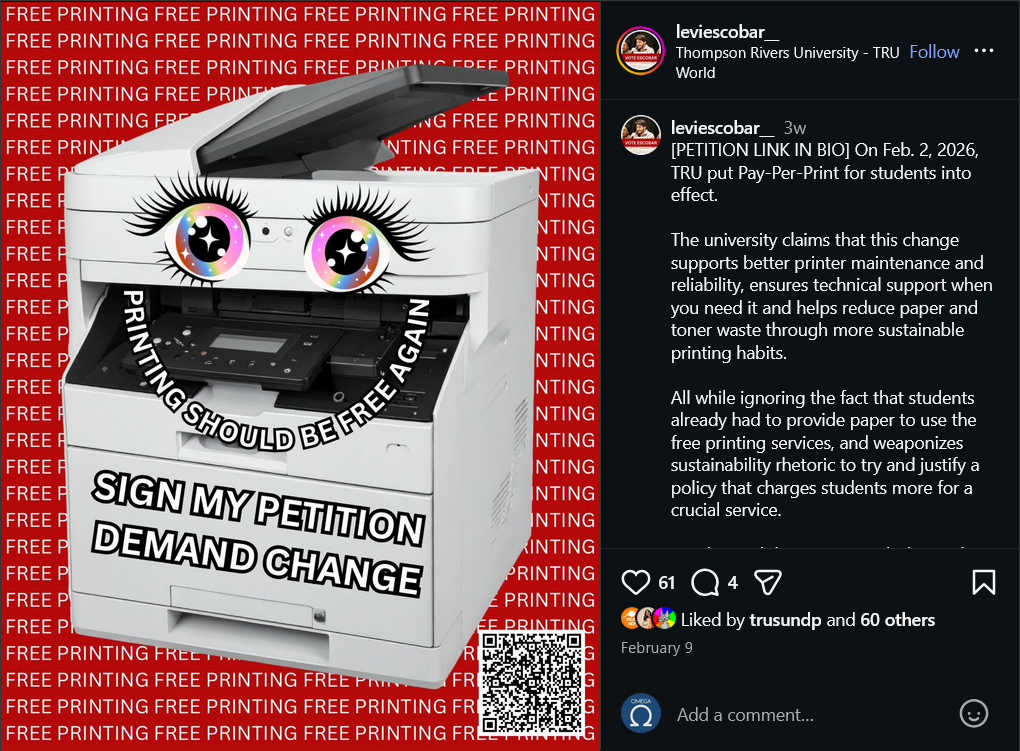
Levi Escobar is a fourth-year philosophy student and a member at large on the TRUSU Services Committee, who is in the running for the TRUSU Board of Directors election scheduled for May 4 to 6. On Feb. 9, Escobar posted on Instagram with a link to his petition to “Condemn TRU’s Pay to Print Policy.” Escobar disagrees not only with the justification that pay-per-print is sustainable, but also with the claim that it will improve printer maintenance.
“In terms of sustainability, students already have to provide their own paper, so that’s already creating a paywall existing already. So, in that sense, I don’t buy the idea that this is somehow sustainable for the environment. And in terms of the other justification regarding better print maintenance, quite frankly, I dont think both paper and printer maintenance are mutually exclusive,” Escobar told The Omega. “It sets the university’s reputation back, with the environmentalist movement and sustainability. To be frank, I find it hypocritical because TRU wants to also build an AI data centre, courtesy of Bell on campus. Let me put it this way: it’s not environmentally sustainable.”
Escobar isn’t the only one tied to TRUSU who wants to see changes. Abdus Khan is a second-year business student and a director with the TRUSU entertainment committee. Speaking with The Omega, Khan said his initial reaction to the policy was strongly negative, particularly due to the university’s sustainability framing.
“I was absolutely against it at first,” Khan said. “I didn’t understand how charging printing suddenly made things more sustainable.”
However, Khan explained that his position evolved after learning more about the infrastructure and costs involved in implementing the new printing system. He noted that printers were purchased and replaced long before the policy was announced, and that reversing the decision entirely may not be realistic.
“To ask the university to just undo months of planning and investment would be unreasonable,” he said. “Printing is still an essential part of the student experience, so the goal now should be to find a middle ground that works for both students and the university.”
Rather than restoring fully free printing, Khan outlined a three-part proposal he plans to present during upcoming consultations with the university administration and ancillary services.
First, he suggested a multi-year price freeze to prevent sudden increases in per-page printing costs. Second, he proposed that each student receive a small printing credit at the start of every semester, amounting to around $10, split evenly between student fees and university funding. According to Khan, this amount would likely cover most students’ academic printing needs.
“Each side takes half the hit,” Khan said. “That way, students aren’t constantly reaching into their pockets for something many courses still require.”
Finally, Khan emphasized the need for better training and communication around the new system. He argued that students should not be forced to troubleshoot unfamiliar technology during high-pressure academic moments.
“If a student is in a rush to submit an assignment, they shouldn’t be wasting time figuring out how the system works,” he said. “There should be proper onboarding and guidance.”
Khan also confirmed that neither students nor student representatives were consulted before the policy took effect. Like the rest of the campus community, TRUSU directors learned of the change via a mass email.
“We weren’t informed beforehand,” Khan said. “That’s why consultation now is so important.”
According to Khan, TRUSU is expected to meet with university facilities and ancillary services on March 10 to discuss student concerns and possible revisions to the policy. In the meantime, he plans to post explanations and proposed solutions on social media to gather informal student feedback.
“There’s a lot of misinformation and confusion right now,” Khan said. “Before we go into those meetings, we need to understand where students actually stand.”
As debate continues on campus, and as petitions opposing the policy gain traction, both critics and student representatives agree on at least one point: decisions affecting essential academic services should involve students from the outset.
This article has been updated. A previous version identified Abdus Khan as “Abdus Samad.” Changes have been made to fix this error.
The Petition is almost at 200!
Let’s keep the momentum going.