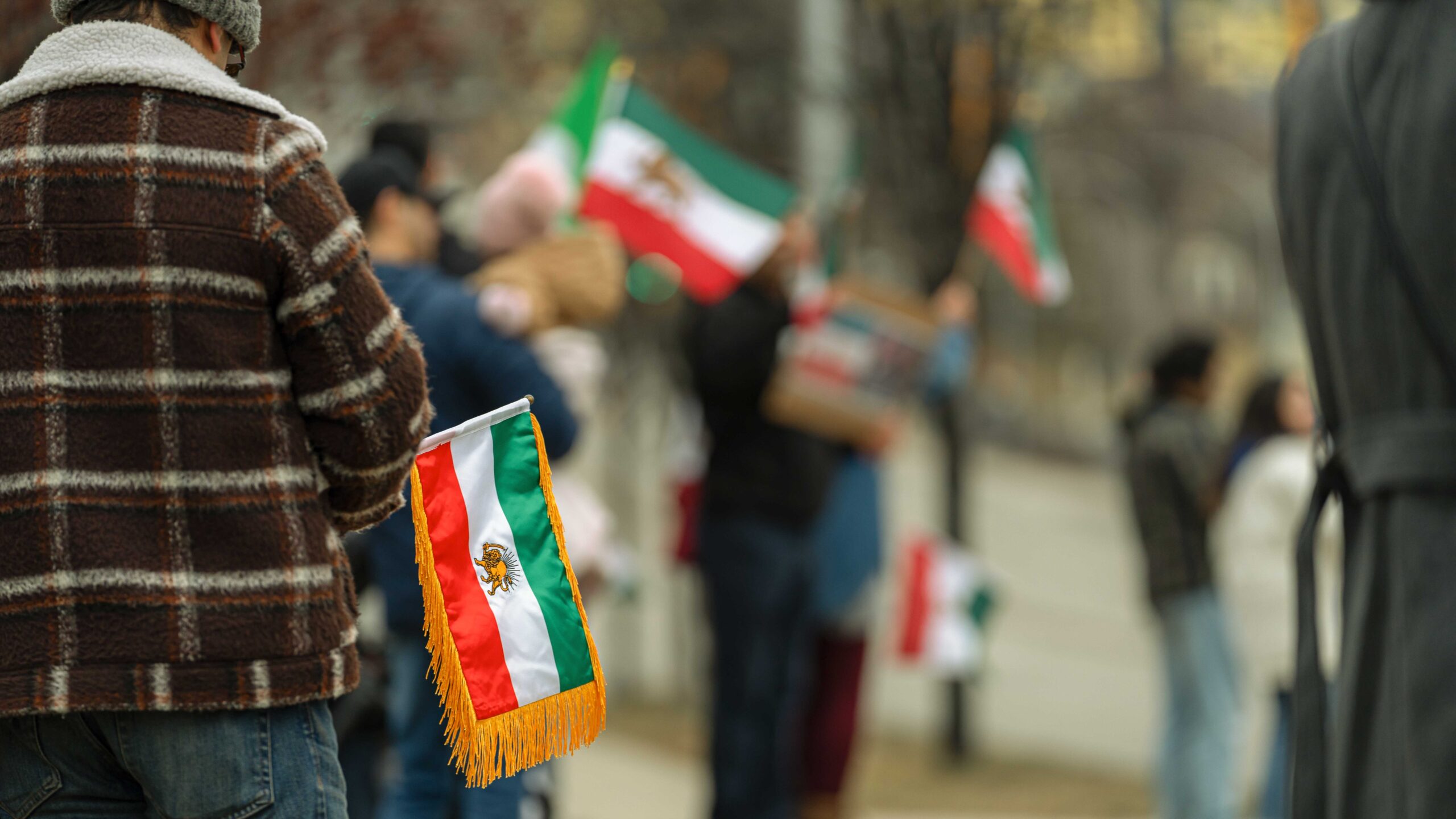
Widespread protests in Iran began on Dec. 28, 2025, due to a deepening economic crisis highlighted by currency devaluation, an increase in inflation and ongoing political repression by the Iranian government.
Since then, the protests have evolved, expanding to include a broader call for government reform. In Iran, these demonstrations have been met with resistance by Iranian authorities through arrests, internet shutdowns and widespread severe violence resulting in rising death tolls. At TRU, Iranian students say the situation back home continues to shape their sense of security, finances and academic focus.
“After 47 years, we are here,” said Ali Alizadeh, an Iranian student at TRU. “We do not want any justification for the regime. Nothing. We just want this change once and for all.”
For Alizadeh, the unrest unfolding in Iran is not a distant political issue discussed only in international headlines. It is something he carries with him into classrooms, during conversations with peers and while navigating daily life in Kamloops.
“I had classmates ask me, ‘Is there a war in Iran?’” Alizadeh said.
That sense of disconnect is echoed by other Iranian students at TRU, many of whom describe feeling isolated as communication blackouts continue in their home country.
“When there is no connection to my family back home, I absolutely lose my sanity,” said Jane Doe 1, an Iranian student at TRU who spoke on condition of anonymity due to fears of retaliation back in Iran. “I lose focus. I can’t work, study or eat.”
Doe stated that prolonged internet shutdowns leave her and her peers abroad in constant uncertainty.
“We don’t know who is being killed,” they said. “It might be my neighbour today. Tomorrow, it might be my own relatives.”
Professor Sairo Bano, a political science scholar whose expertise includes but is not limited to Middle Eastern and Asian politics, human rights and authoritarian regimes, said the protests are rooted in long-standing economic and political pressures.
“The protest started because of soaring inflation, because of the bad economic situation that people are facing in Iran,” Bano said. “It’s hard for them to afford the basic needs of life.”
According to Bano, Iran’s currency devaluation, unemployment, and the effects of prolonged sanctions have intensified public frustration, pushing economic grievances into the political realm.
“No matter if you are a student, a retiree, in business, or in a job, it’s affecting every field of life,” she said.
For TRU Iranian students studying abroad, that economic crisis has immediate and tangible consequences.
“The value of our currency has dropped so significantly, and right now it is like zero compared to the dollar,” said Jane Doe 2, who was also granted anonymity over fears of persecution in Iran. “Prices are going up, and there is high inflation.”
They said financial instability at home directly affects their ability to remain enrolled at TRU.
“It is impossible for my family to send me tuition or living expenses,” Doe 1 said. “They have to choose between supporting themselves or supporting me.”
Bano said Iran’s response to protests follows a familiar pattern seen in authoritarian regimes, particularly when public dissent becomes sustained.
“Dictators and authoritarian regimes try to cut communication between people so that they cannot coordinate with each other and cannot send videos to the outside world,” Bano said.
For students abroad, those shutdowns deepen fear and helplessness.
“When there is no internet, you are completely cut off,” Doe 1 said. “You don’t know what is happening to your family.”
Bano added that the Iranian state media plays a critical role in shaping domestic and international narratives.
“They discredit these protests by saying these are agents of America and Israel,” she said.
Students say this framing has consequences beyond Iran’s borders.
“People relate us to the regime, but that’s what Iranians are very against. We are different and separated from the regime,” Doe 1 said.
Despite the scale and persistence of demonstrations, Bano cautioned against assuming that mass protests alone will bring about regime change.
“The most important factor that leads to the fall of a regime is when security forces abandon the regime,” she said. “We haven’t seen that yet.”
According to Bano, Iran’s security forces remain largely unified, allowing the government to suppress protests even when public opposition is widespread.
For students watching from abroad, that uncertainty adds another layer of anxiety.
“There is no freedom there, there is no security there, there is no future there,” Alizadeh said.
Beyond fear for loved ones, Iranian students said the crisis has affected their academic performance and mental health, particularly as the semester begins.
“It is very difficult to sit in class and focus when we haven’t heard from our families for days,” Doe 1 said.
On Jan. 18, TRU Iranian student organizers held a two-part event, a protest outside the Kamloops Courthouse on Columbia Street from 11 a.m. to 12:30 p.m., followed by a gathering on campus at the TRUSU Lecture Hall from 1 p.m. to 3 p.m., where students connected, shared food and continued discussions.
The voices of Iranian students at TRU, along with the analysis from Professor Bano, illustrate how global political crises manifest in the university community not only as distant international issues, but as ongoing realities shaping students’ mental health, finances and their ability to learn.
“We want people to see this as humans, not as politics,” Jane Doe said. “Our basic human rights are being neglected.”