
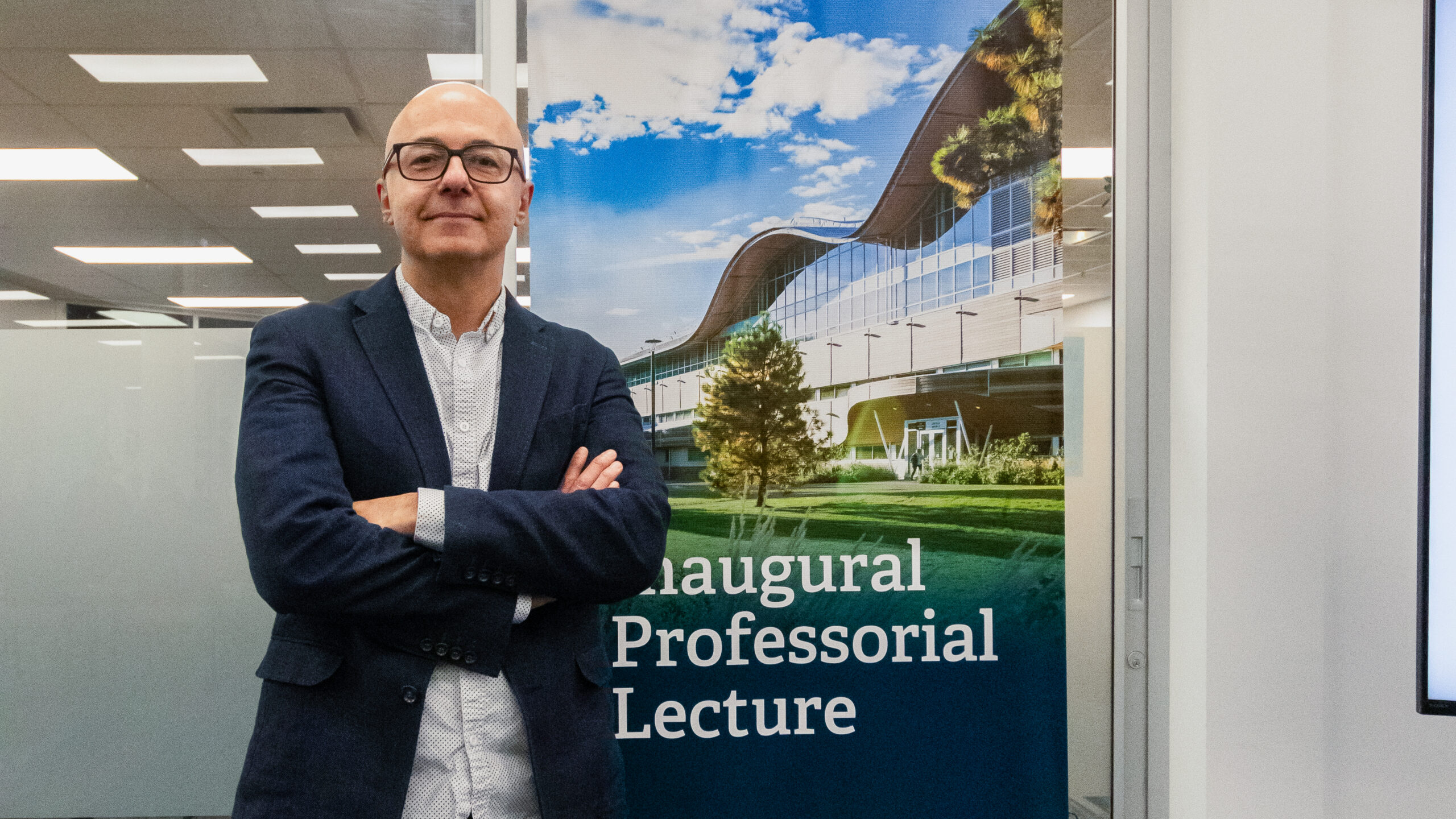
Several times a year, the TRU community gathers for an Inaugural Professorial Lecture (IPL). This event commemorates the promotion of a faculty member to full professorship, a position that recognizes one’s excellence in the domains of service, teaching, and research.
The honoree delivers their first lecture as a newly minted full professor, wrangling the complex world of their research into a digestible presentation for a general audience. On Nov. 18, Salvador Barragan delivered his IPL to a crowded room at the Collaborative Student Space in OLARA.
Originally from Mexico, Barragan completed his MBA at IPADE Business School before coming to Canada to study Management at the University of Lethbridge. He received his PhD in 2013 from Saint Mary’s University in Nova Scotia; his thesis focused on high-performing female managers in Mexico. Joining TRU as an assistant professor at the Bob Gaglardi School of Business in 2014, Barragan made an immediate impact as both a researcher and instructor.
“He’s an amazing scholar,” Bruce Martin, professor of Human Enterprise and Innovation, told the Omega. “He has such deep insight, and he is willing to spend the time to dig deep into the data.”
Barragan and Martin are frequent collaborators; together, they spearhead TRU’s Innovation for Social Good research cluster. Martin emphasized the significance of the IPL as an opportunity to recognize outstanding scholarship and to share emerging research with a broader audience.
Barragan’s students, many of whom attended the lecture in support, emphasized his approachability and openness as a teacher.
“In his class, no answer is wrong,” Oluchi Ajouku, a second-year MBA student, shared.
Omawumi Agboola spoke to the practicality of Barragan’s leadership class, saying she enjoys the “outside the box” thinking that the professor encourages. He allows students to be creative with their solutions to business challenges, as long as they can defend their rationale to the class. Agboola cites Barragan as an “instrumental” figure who helped her develop vital career skills.
As a management scholar, Barragan investigates the intersection between culture, identity, and business. Looking beyond just the numbers, he pulls qualitative findings from participants’ lived experiences. In a 2018 paper, for example, he conducted 22 interviews with female Emirati entrepreneurs to better understand the barriers they face in their personal and business lives.
Recently, Barragan’s research has focused on social enterprises, the central subject of his IPL. These organizations straddle the line between non-profit and private business, he explained, using a commercial model to chase both a social mission and financial sustainability.
Barragan and his team were awarded a $75,000 Social Sciences and Humanities Research Council grant to study Binners’ Project, a social enterprise located in Vancouver’s Downtown Eastside. The Binners’ Project enters into contracts with the city to collect bottles and cans at festivals, providing economic opportunities for marginalized groups, Barragan explained, while building community and destigmatizing bottle picking.
Over time, the researchers have observed Binners’ Project transition from a traditional non-profit model, with the majority of their revenue coming from external funding, to a self-sustaining social enterprise.
However, social enterprises like the Binners’ Project often face ethical dilemmas arising from competing financial and social goals. One example Barragan highlighted is the difficulty of finding enough workers to uphold its contracts, while ensuring that employment opportunities remain available for the intended groups.
These dilemmas, where humanity and business collide, are Barragan’s specialty.
“I think of [him] first and foremost as a humanist,” Scott Rankin, associate professor of Human Enterprise and Innovation, told the IPL audience. “He puts the human first, in the classroom and with his colleagues. And that’s a harder path to take.”