
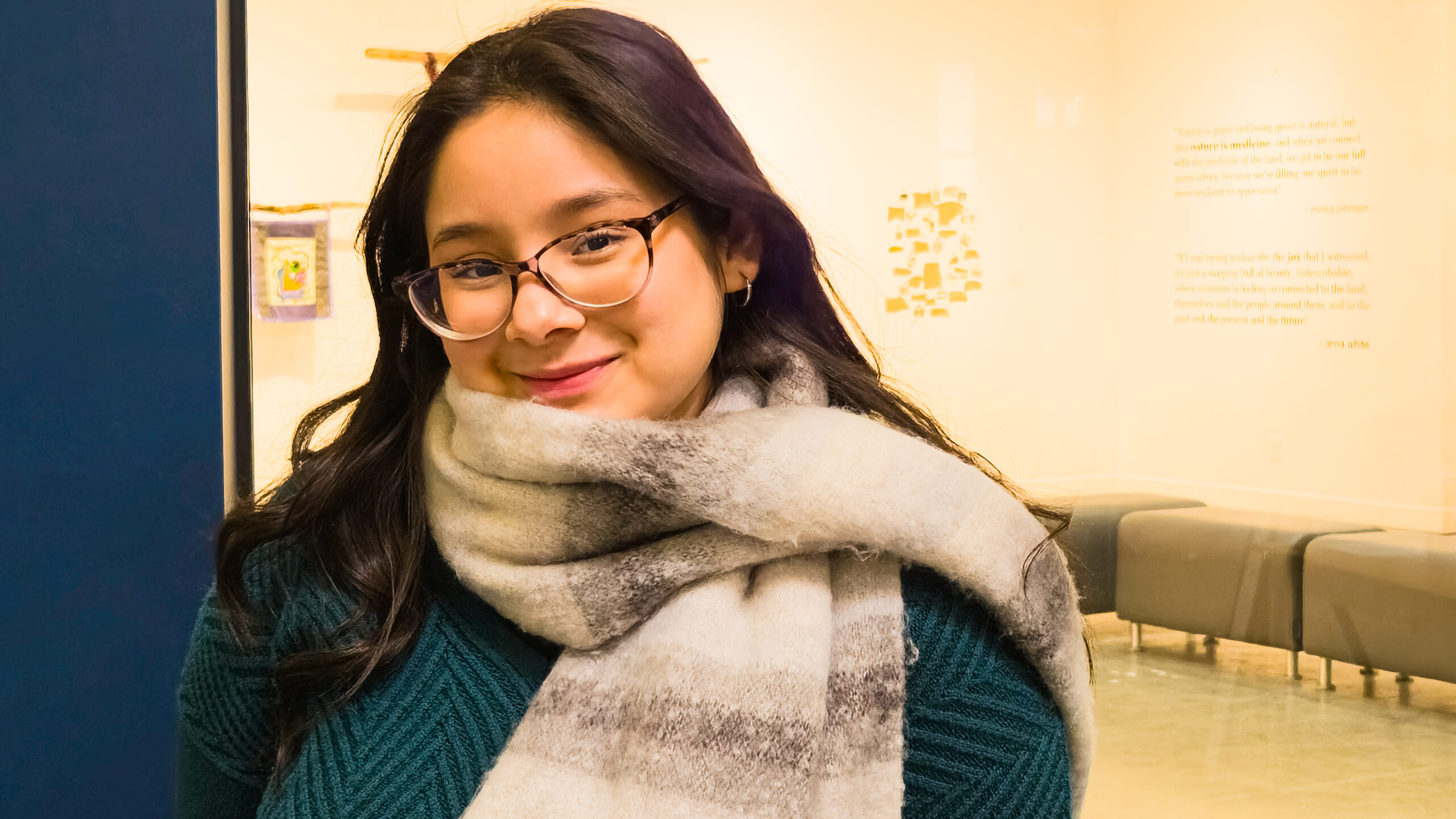
Domenica Randich is a staff writer for the Omega. She came to study Digital Journalism at TRU in Winter 2025, and has shared her thoughts on how a migrant can find freedom without standing next to those who know their story.
What is freedom without community? Exploring the meaning of the concept while discussing the ongoing war in Ukraine, historian Timothy Snyder wrote a political and philosophical essay stating, “Freedom is about moral commitments and multiple possibilities.”
As an international student who discovered how choices and chances could reshape freedom, I began to question what it truly takes to build a brighter future. Despite endless opportunities, there was a missing element that made my foundation weak—or in other words, a thinned freedom.
Like many Latinos, my parents also believed in the American Dream. Though they were unable to leave our country, they raised my siblings and me to aspire for a better future where possibilities were endless and where freedom had no limits. I am sure others like me have heard the same sentiments.
Now, according to El País and the Hispanic Sentiment Study 2025, more than 48 per cent of the U.S. Hispanics believe this concept is disappearing within the community, arguing “…the ideal is either out of reach or a relic of the past.”
Seeing this data, I am reminded of Snyder when he writes, “We like to think that people are free when the correct army arrives: a liberation. But removing evil is not enough.”
As an example, in terms of the war in Ukraine, he mentions Ukrainians don’t expect the Americans to bring them freedom, but rather American weapons that open possibilities for building it. This is where positive freedom emerges. When civilians can be true to their moral commitments and have multiple possibilities.
In my case, it was not about waiting for an army to arrive but packing my things and leaving the evil behind. But as the historian implies, this is not freedom.
The reality is that many of us get on a plane to find greater opportunities, equitable salaries, fair governments and above all, guaranteed safety. But when have we stopped to think of what we are leaving behind? For me, it was when I said goodbye to my family and friends as I realized that, alongside my rejection of governmental corruption, I was leaving the familiarity of my community.
“But freedom is not just an absence of evil. Freedom is a presence of good. It is the value of values, the condition in which we choose and combine the good things, bringing them into the world, leaving our own unique trace. It is positive,” Snyder writes, presenting an argument that makes me question my decision to leave. If I had something so good, why did I make that choice? Without those who could hold my hand through the hard times, I realized that back home, what ignited my freedom was the people I grew up with. Having them by my side made the bad tolerable through everyday experiences, such as eating a typical dish after a night out. But I struggled to recognize how valuable it is to have a community because escaping wrongness was my priority.
It has been about a year since I started studying and working in Canada. As expected, my life has improved in the ways I thought it would. The professional benefits I have encountered have expanded my network, augmented by exceptional professors who have shaped my excellence in my field. As far as economic opportunities go, I have obtained two part-time jobs while studying, one of which allows me to gain experience in the journalism industry, which is often restricted by privilege and sometimes by social pressure in what the West considers the “global south.” What’s more, my ability to take the bus and study in my favourite coffee shop without fear of being robbed is a basic right under the facade of luxury.
But being afforded so many opportunities in a new home without your home community by your side feels like knowing there’s gold behind a door and not having the key to open it, while other times, it is like having the key, but not wanting the gold because you have no one to share it with.
“It is cowardly to believe that freedom is just negative, just an absence. When we think of freedom that way, we leave all the hard questions open: Who are we? What do we care about? For what will we take a risk?” Snyder questions. In our home country, we may have a community but fewer opportunities for growth. In Canada, we may have more of the latter, but weaker roots. Freedom feels incomplete when we have belonging without opportunity, or opportunity without belonging.
Travelling abroad taught me that freedom is not secured by departure alone. Not all, but many migrants and immigrants who keep opening doors despite leaving their communities behind are in pursuit of having a chance at opportunities. And just like me, they keep being resilient because of the like-minded people they meet along the way.
Regret isn’t the answer, but re-evaluating our commitments might be. To keep going, we must rebuild a community throughout our journey, but never forget who pushed us through the first door. Migration may expand my opportunities, but we can only achieve freedom if we have people who can guide us to the next door. This is how we turn opportunities into dreams—one that may allow us to create a new home.
Domenica’s article really moved me. What a powerful message about resilience and self-reflection.
Great article, keep growing!
you go, girl!