
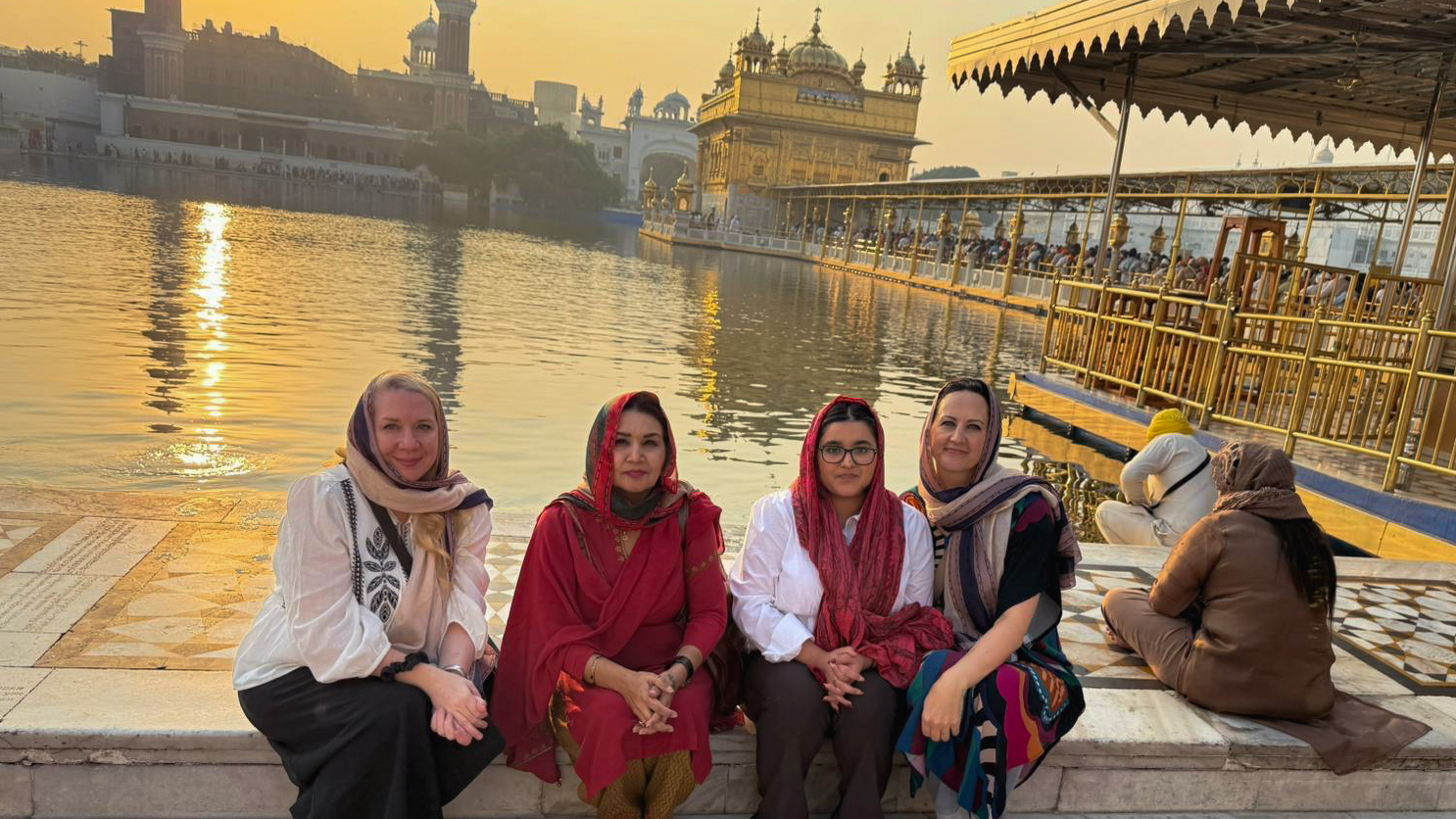
This summer, the School of Social Work and Human Service, in collaboration with Consent Café, will lead a 10-day field school trip to India. The 2-week international study abroad opportunity will be open to social work students and other interested students.
In the works for two years, the field school was conceived by Tanya Pawliuk, associate teaching professor in the school of social work, Chelsea Corsi, senior coordinator at the Wellness Centre and Sabreet Kaur Ghumman, a TRU social work alum. Together, Pawliuk and Corsi founded the Consent Café, an activity-based program for consent education, communication and violence prevention targeted at youths and young adults. After working as a program assistant for their Consent Café pilot, Ghumman developed a lasting relationship with the co-founders and later invited them to her community for the program.
“The community is really excited about us going and very welcoming,” Pawliuk said.
Other partners and collaborators from India include Mini Kaur Ghumman, Senior Nursing Officer, and Parminder Singh Ghumman, Consent Café Partner and Ambassador.
Gurdaspur, the relatively small-to-mid-sized Indian city of around 2 million people, is where students will land on Aug. 3. Corsi and Pawliuk went on a site visit last October for 2 weeks, where they presented at 8 schools to over five hundred people, gaining the support of locals for their proposed program. As a result, they developed relationships with the healthcare and education sectors, as well as the government.
“There’s a lot of cultural nuances to communicating about consent and speaking about communication,” Corsi said. “So, we’re also learning. It’s a cross-cultural learning opportunity.”
India seems like an obvious choice for a field school: despite the recent international student drops, the Indian population at TRU still makes up a significant percentage of the international student population. A stronger connection with India can strengthen bonds and build greater understanding within Canada, especially considering the rising levels of anti-Indian racism in the country.
To Pawliuk and Corsi, their connection with Ghumman is a testament to these strong bonds.
“Aren’t we lucky to have had an international student come here and build the kind of relationships where she’s not just taking her learning back, but also her faculty back with her?” Pawliuk said. “That’s profound.”
The program will be part of the social work course SOCW 3300, which explores the economic, social, political and cultural conditions in India, the effects of globalization and marginalization on citizens, and social welfare policies and developmental strategies. Important for Corsi and Pawliuk is the opportunity for students to develop cultural sensitivity and humility through this experience.
“The learning that I had, doing my practicum as a nursing student in Nepal, transformed who I am as a person,” Corsi said. “And so, it’s very meaningful, I think, to let students know that it’s not just about them going to deliver whatever it is; it’s about a learning that, I believe, will last a lifetime.”
Alongside this unique experience, though, students are still expected to meet certain requirements.
“When they are in India, students can expect to engage in collaborative learning with other university students living in India,” Pawliuk said. “That could be learning opportunities, seminars, but also through Consent Cafés.”
Students will also contribute to, collect and disseminate information based on their experiences and learnings. The hope, Pawliuk said, is to create something that can be brought back to the TRU community—a real testament to the idea of cultural exchange.
“It’s interesting to know how connected we are,” Corsi said. “Even though we’re all unique, when you start talking to people, you realize that all people want to be safe. They want to be loved. They want to be seen. [We have] so much in common.”
The initial costs to attend the field school will run around $2,100 (not including airfare, meals, spending money, or tuition), though students will receive a $500 grant from the university after completing all necessary training. The course will begin during the second summer intersession, on June 29.
Corsi and Pawliuk have already held a few information sessions, where they shared important details and specifics with interested students. The next two sessions will be held on Feb. 5 at 9:30 am in OM 1240, and on Feb. 11 at 3:00 pm in OM 1335.
Due to the cost of both the course and travel, there is a limited number of seats. If you’re interested in the field school and would like more information, you can find a sign-up form here.