
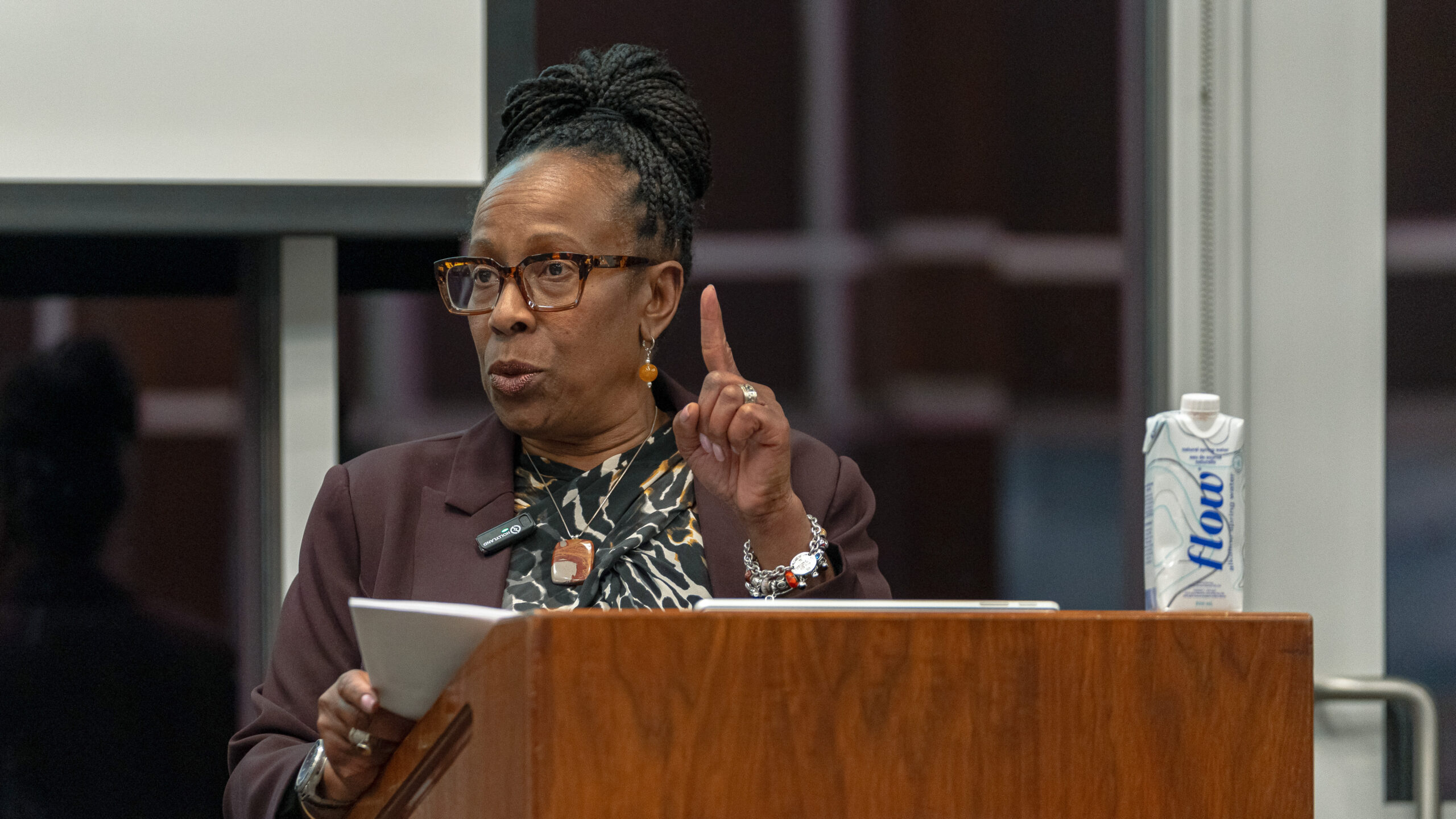
Social worker, advocate and educator, Marva Ferguson, made an appearance at TRU this past Tuesday to give a talk on anti-Black racism in academia. The event, which was held in recognition of Black History Month, was sponsored by the TRU Faculty of Education and Social Work, the Office of EDI and Anti-Racism and TRU World. During her hour-long lecture, Ferguson expressed her curiosity about one major issue.
“What has happened,” she wondered, “since George Floyd?”
The talk, titled Black History Month: Silencing and Silent in Fugitive Spaces, was increasingly relevant in the face of what seems like growing backlash of Equity, Diversity and Inclusion (EDI) policies across the country. Her question about the changing state of the world since the 2020 civil rights protests sparked by the police murder of George Floyd pokes at this problem.
In recent years, we have seen what can be described as a rolling back of many of the gains from those protests. Ferguson asserts that minority voices, and, for this conversation in particular, Black voices, are once again being silenced and pushed to the margins.
She begins by retelling her own experiences as a Black woman in academia, the racist treatment she’d received both from individual students and colleagues, as well as institutionally.
“And then, [Floyd’s murder] happened,” she said. “There were lots of demonstrations, there were lots of discussions. For some reason, there was a change in the community.”
Ferguson began her advocacy career early, writing frequent letters to newspaper editors back home in Jamaica. It was a learning lesson for her: there were avenues to getting your voice heard, even in situations where you were too often overlooked or sidelined. Ferguson wrote letters about anything from infrastructural complaints to highly contentious issues that posed real risks to her safety.
This habit remained even after moving to Calgary in 1993, where she encountered an environment that seemed unwilling to do the hard work of racial justice. People found words like “racism” and “Black” uncomfortable, and so many of these conversations were taped over.
“I continued to speak out, and I continued to advocate,” she said.
As an associate professor in the Department of Child Studies and Social Work at Mount Royal University in Victoria, Ferguson spent many years advocating for representation in academia. She has extended her interests in anti-Black racism, anti-oppression, and critical race theory to her approaches both within and outside of the classroom. In 2018, noticing the lack of acknowledgement of Black history in her department, Ferguson began raising funds to address it.
“This year marks the ninth year,” Ferguson said of the program she pioneered. “Last year we had over 300 participants attending the event, and this year is actually going to be bigger.”
The willing arm extended to work like hers, especially after the 2020 Black Lives Matter protests, now seems to be retracting.
“We are seeing the removal of books from libraries,” she said. “We are also seeing the dismissal of the LGBTQ+ community—they are now struggling, and a lot of individuals [from this community] are in silent mode. There’s also the termination and demotion of Black professionals in the community.”
She also discussed the recent moves across Canada to rebrand EDI. At her university, the EDI office was renamed “The Office of Community and Belonging.” Similarly, the University of Alberta previously announced that it was dropping the language of EDI in favor of the term “Access, community and belonging.”
Ferguson outlined another means of advocacy that has been similarly under attack: art.
“Woody Guthrie spoke about ‘This Land is Your Land,’” She said. “But many of us are feeling the pain of being treated like fugitives in the land that is supposed to be supportive of us.”
Since last year, public artworks dedicated to both George Floyd and the Black Lives Matter movement have been removed. From Utah, Texas, D.C. and beyond, several pieces of protest art have been taken down, and murals literally whitewashed, often with developers citing vandalism and maintenance costs as reasons. Ferguson said that there is a need to pay careful attention to this particular phenomenon.
“A few years ago, everything seemed okay,” she said. “And I don’t know what happened. We are seeing, and we are experiencing anti-Black racism in the silencing of voices.”
Unwilling to end on a negative, Ferguson insisted that attempts to silence marginalised voices do not necessarily mean they are voiceless.
“There are gonna be times when you feel that you don’t have a voice to speak out,” she said. “Write it down. Use your pen, use your pencil. Use the support that you have. There’s a tendency for students coming from international countries to be isolated. I ask for faculty to do more, because in doing more, we get more from our students.”
She points to the Scarborough Charter, a higher-education framework created in 2021 to combat anti-Black racism and promote Black inclusion in post-secondary spaces.
“Universities are now called on to foster an inclusive environment,” she continued. “It starts with the course outline, it starts with the curriculum. It also means removing barriers for success.”
This month, on Feb 25th, TRU will become the 61st university in Canada to sign on to the charter.