
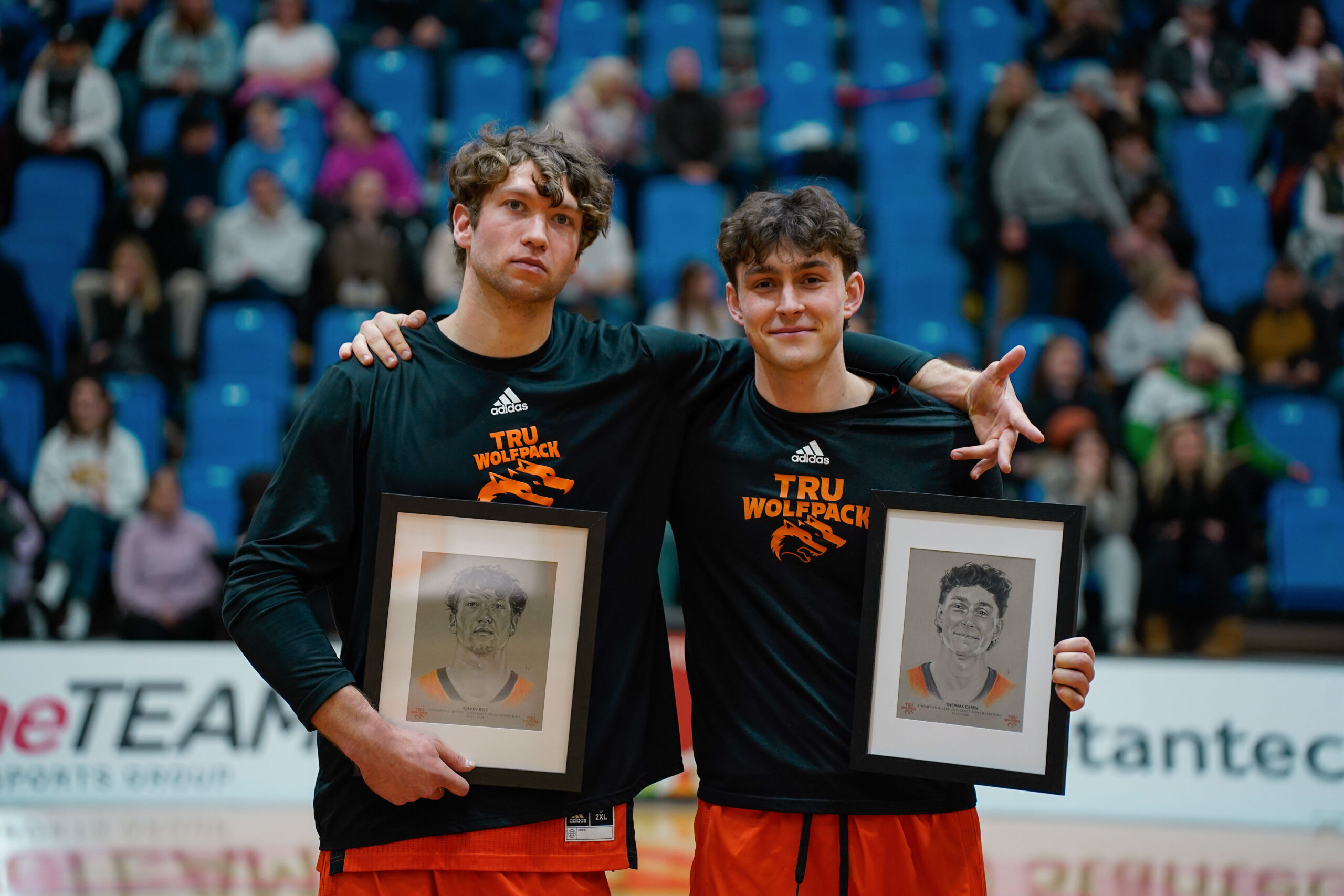
Recently, The Omega sat down with graduating men’s basketball team captain Thomas Olsen to talk about his journey to TRU through the COVID-19 pandemic, the impact of all his coaches on his career and his impressive all-Canadian academic achievements. Olsen even expanded on what’s on the books for him next, and why one of his favourite memories at TRU involves a local elementary school student.
AL: You’ve been here since 2021, and you’re wrapping up your university career at TRU. What has this journey meant to you to play with TRU for all that time?
TO: It’s been really special. To learn from my first coach, Scott Clark, who was a really hard-nosed old school coach, I think I learned a lot of lessons from him, [on] how to be a leader and how to develop as a young man, on the court and off the court.
That laid a really strong foundation for these last three years, where I got to play with Chad and my role [has] slowly grown from just a player to a leader on the team, [to] now a team captain.
It’s been really special to see our program grow from not very successful in Canada West to last year upsetting U of A, beating them for the first time in program history and making it to the Canada West Quarterfinal. Now this year, setting program history again, with the best start of season record, again, in program history. Getting a top 10 national ranking for the first time in 10 years, and now with hopes of hosting a playoff game and making some noise. I think it’s just been a really cool journey about individual personal growth into a leader, as well as watching our team become more successful and establishing a really strong culture and sense of identity in [the] Canada West [conference].
AL: What brought you to TRU? What made this program feel like it was the right fit for you?
TO: Coming out of high school, it was the COVID season, so I actually didn’t have a grade 12 season. It was really hard for me to find a university to go to play basketball. I ended up sending out 25 plus emails, heard back from maybe four, and two of those weren’t even real emails back, just invites to camp. I thought my university career or my basketball career was going to be over. But then Coach Clark called me, and immediately we clicked. I loved his intensity, [and] I loved his philosophy for the game.
He told me that everything is going to be earned here; nothing’s promised. That really excited me. The prospect of hard work being rewarded and a hard-nosed mentality was exactly who I was as an individual. So immediately after that phone call, I knew TRU was the spot for me. As soon as restrictions were lifted for a week, I drove up here, got a workout in with the coach, and I told my parents if he offers, ‘I’m signing that day up.’ He gave me the offer, and I literally signed it on the drive home. I haven’t looked back since, and I’ve loved TRU ever since. If I could go back, I’d pick TRU every time.
AL: You’ve been a really integral part of the team through your career. Across 91 games, you’ve played over 2000 minutes. What does that kind of consistency in your gameplay and the trust in your leadership mean to you?
TO: The trust, it means a lot. It’s been years in the Making. It’s been me learning about what the team needs from me and adapting to that, [then] accepting my own role as a hard worker, a defender, and trying to excel in my role. Scott [Clark], my first coach, had a saying that was ‘be a star in your role,’ that’s something I’ve really adapted, especially with this new coaching staff.
For me, it means being a leader and being an example, on the floor with my effort, communication, showing up early [and] staying late. As well as being an example in the classroom and trying to set that culture of hard-nosed, gritty teams that will defend hard, outwork you and make everything you do difficult, no matter if they’re a top 10 team in the country or a bottom 10 team. We approach it the same way. We have our standards set. We just try to work hard and make it difficult for everybody.
AL: Throughout your career, was there a moment when you really felt yourself kind of step into that leadership role?
TO: For sure. I think a big moment for me was the tragedy that happened three years ago with the men’s volleyball team. I think that I took it myself, along with other leaders on the team, took it upon ourselves to make sure we stayed together through that. I think that was a moment for me when I really stepped into my own about how I can be a support system for my teammates, and ‘how can I keep our group together?’
I learned a lot from that. I learned the importance of communication and being a support system for everyone around you, especially as an older guy on the team. I’ve tried to maintain being a support for my teammates, of course, on the court, but especially off the court.
AL: During the UBC series this year, you posted career-high stats in game rebounds and assists. What goes into prepping yourself for games against top schools like that, and how has your pre-game mindset shifted throughout your career?
TO: It’s just the confidence that we have in our group that’s changed, [and] you can feel it in the locker room. We have this sense of belief that no matter who’s across from us, we have a chance to beat anybody. As long as we stick to our principles, play hard and play as a team.
In the past, we’ve played some of these higher-ranked teams and been hesitant in that, not as confident, but this year we really have that sense of belief that nobody can stop us, and if we just stay together, play for each other, we can beat anybody.
AL: Looking back on your past career here, is there a moment that you’re just never going to forget?
TO: I got two. The first one was three years ago when we played at the elementary school game here at TRU. I started that game and every time we play, we run out of the tunnel and the gym’s full of kids, like there’s not an empty seat. I remember running out, and there was a poster right beside the tunnel, and there was a kid who had a TRU jersey drawn with the number 15 and ‘Thomas Olson’. I remember thinking this kid took the time to draw out the TRU jersey, and out of all the players, he chose to put my number and not just my number, but my name. That was really cool ’cause he could’ve picked anybody, but to, to see that, and to know that I had that impact on that kid in the community. It was just a really, really cool moment.
I still have the photo on my phone, and I think about that sometimes. I think about the responsibility of us WolfPack athletes with kids in the community, as you know, we’re the athletes that they look up to, and just to see that personified in that kid was really special, and I’m never going to forget that moment.
Then my number two was last year, my brother played on UBC, and I got to play him for the first time. Being on his team growing up and playing with him in the driveway was always special for my brother and me. Then, to see his development as a player firsthand, matching up with him was an unforgettable experience. Talking trash with him and competing with him was one of the most special moments in my basketball career. I’m never gonna forget that one.
AL: You’ve talked a lot about your first coach and then the coaching staff now and what they mean to you. Is there anyone who stands out who has had a really big impact on your journey here at TRU?
TO: I mean, Scott, of course, has been instrumental in my development as not just a leader but really as a young man; he’s been a really big role model for me. Just in the way he approaches not just basketball, but life. The principle of setting high standards for yourself and holding yourself accountable to those is something that I’ve applied to my academics and [to] every other aspect of my life. I remember we had a conversation when he retired, and I won’t forget this. He said, ‘You know, I never won the big game. I never won a national championship, but I stuck to my principles and, looking back, that’s something I can be proud. I stuck to my principles. I set high standards for myself, and I can retire happy again.’ And that’s kind of how I’m approaching my life: if I do my best, set high standards, I can be happy with any result. So I learned that from Scott.
Then Chad’s just an ultimate competitor. He says all the time, ‘Everybody loves to win, but only the best players hate to lose,’ and like that’s who Chad is. He’s an ultimate competitor, and that inspires me to compete and get up and get ready to play every game.
One more [person] that I just want to shout out would be Ted Murray. He was an assistant coach for my first two years with Scott and one of the smartest basketball minds I’ve met in my basketball career. I learned a lot about the game through him, but also he was there for me for some of my lowest moments at TRU when I was questioning my own confidence and whether or not I was meant to be here. He was just a steady presence, and he always inspired confidence with me and I don’t think I would’ve been able to finish out my career here if it wasn’t for Ted.
AL: Among a lot of your accomplishments, you’ve been just one of 22 students who’ve been named a five-time academic all-Canadian throughout your entire career. How have you managed to do that with being a chemical biology major, and how does that make you feel?
TO: A lot of 5:00 a.m.’s in hotels. A lot of studying on team buses, airplanes or at airports, which is really tough. But when you love it, it’s easy. I love science, I love school and I love the classroom. It’s been hard having to balance that, but I wouldn’t change it. I think a big part of what made it easy is the support systems we have at TRU. We have it good with P.A.C.E (Pack Academic Edge) and with veterans that have helped me learn how to study and then time manage. I’ve had really good support systems here. I don’t think it would be possible if it wasn’t for those veterans and supporters.
AL: As you kind of close off your chapter at TRU, what’s next for you off the court?
TO: Hopefully, I’m going to med school next year, and I hope to study medicine, hopefully do some research projects while I’m there, and hopefully either get into family medicine or orthopedic surgery. So that I can work with more athletes trying to get them back onto the court, or be a family physician in some type of clinic.