
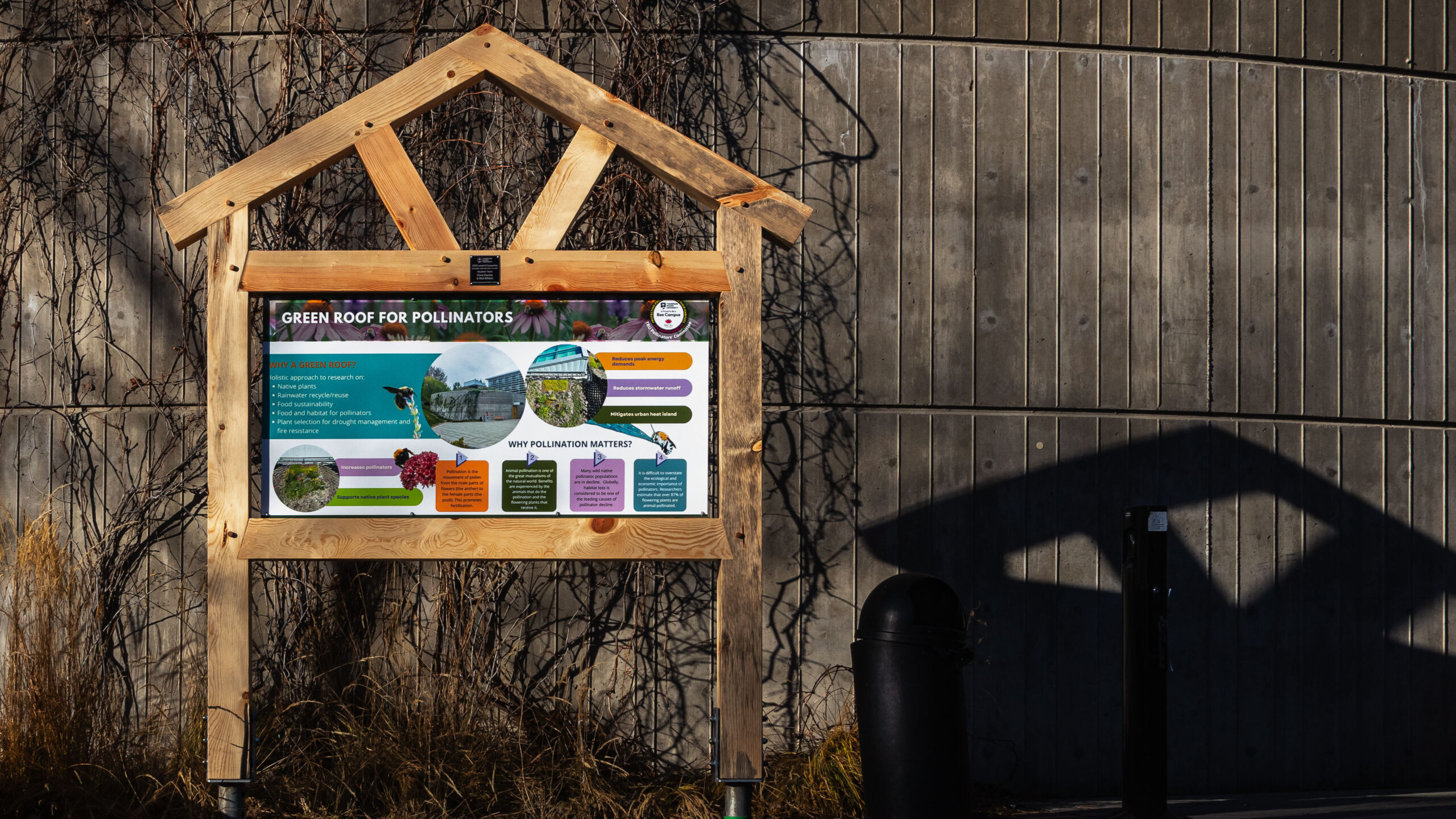
TRU is buzzing with excitement over the new signs that popped up across campus this semester.
Installed last December, the interpretive signs highlight the university’s efforts in protecting native pollinators through research and education. There are six of these signs scattered across the campus, depicting important information about animal pollinators.
Pollinators are vital to local and global ecology. According to some estimations, a vast majority of the earth’s flowering plants—over 87 per cent—rely on animal pollinators to reproduce. Approximately 75 per cent of major crops consumed by humans depend on animal pollinators, accounting for around 35 per cent of food production by volume. Without animal pollination, we can say goodbye to our blueberries, watermelons, apples, almonds, avocados, coffee, and so many other well-loved, healthy and staple foods.
In service of their sustainability goals, TRU’s latest venture brought local community members, Indigenous students, and multiple faculties and schools together to complete this project. The stated goal, according to Canada Research Chair Courtney Mason, is to support “native pollinator education.”
TRU was also recognized as a Bee Campus in April 2024, getting a Bee City Campus designation and endorsement from Bee City Canada. The designation acknowledged the university’s commitment to helping local pollinators.
The university has been involved in significant habitat creation on campus, with native plant gardens, a pollinator garden, and an orchard with dozens of fruit trees. It also has a small colony of honey bee hives on campus, a project started by former Culinary Arts instructor Ron Rosentreter in 2011 to teach students about sustainable food and ecosystems.
The institution’s Bee Campus status was renewed in February 2025. TRU has continued to invest more in native bee pollinator habitats.
Bee City Canada is a nonprofit that supports communities in protecting local pollinators. They achieve this through community, campus and school recognition programs such as the Bee Campus status. The program requires its participants to dedicate themselves to creating, maintaining and improving pollinator habitats, educating community members and celebrating pollinators to raise awareness. Since its founding in 2016, Bee City Canada has garnered nearly 200 members across Canada, including 92 Bee Cities, 84 Bee Schools and 23 Bee Campuses.
The signage across the university grounds informs the community in plain language about the pollinator habitats on campus, why pollinators matter, how native plants support them and how Indigenous stewardship practices contribute to healthier habitats. They include illustrations of native plants, bees, butterflies and birds, as well as information about how these species interact.
To make this a community effort, trade students from the university’s carpentry program were brought on to support the construction of the signs. Coordinated by carpentry instructor Greg Alm, the students designed and put together timber frames made from campus trees removed during the construction of TRU’s new Indigenous Centre. The project was integrated into their education as part of their Level 4 Carpentry course.
The World Economic Forum’s 2025 Global Risks Report ranked biodiversity loss and ecosystem collapse as the second-most severe global risk over 10 years, coming just behind extreme weather events. At the same time, the United Nations has stated that biodiversity is our best hedge against climate change. Over the years, British Columbia has seen a significant loss of habitat and biodiversity due to climate change, resource extraction and pollution.
According to Mason, native pollinators are critical to maintaining threatened ecosystems and support biodiversity.
The signs are just one step towards TRU’s ultimate goal. It hopes to integrate pollinator conservation into broader infrastructure upgrades across campus, and plans to tie this initiative into its carbon-neutrality goals.